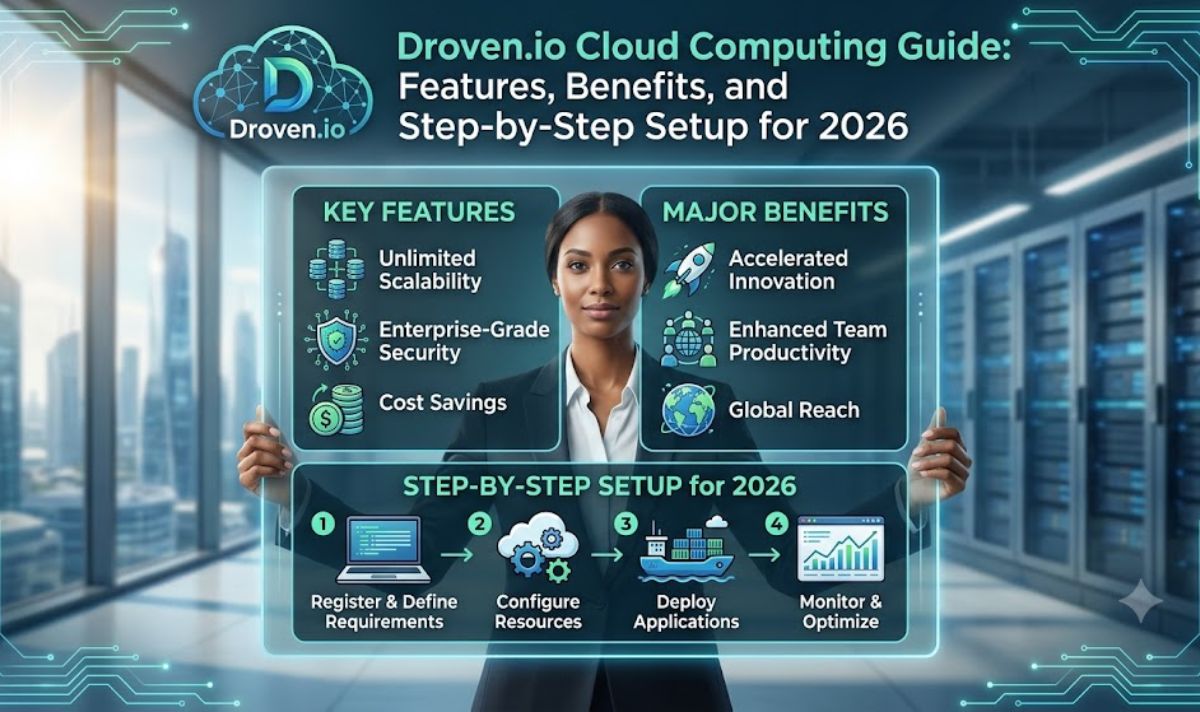
Cloud computing has quietly become the backbone of how businesses store data, run applications, and scale operations. Yet most guides either drown readers in jargon or skip the practical steps entirely
. This Droven.io cloud computing guide breaks the topic down in plain language covering what cloud computing actually means, the models and features that matter in 2026, and a step-by-step framework for setting up a working cloud environment. Whether you’re a founder evaluating options or a developer brushing up on fundamentals, this guide gives you a clear, no-fluff starting point.
Bio Table
| Field | Details |
| Reviewed by | Droven.io Editorial Team |
| Focus Area | Cloud Computing, IT Infrastructure, Emerging Technology |
| Last Updated | 2026 |
| Content Type | Educational Guide (Vendor-Neutral) |
| Audience | Business owners, developers, IT professionals, students |
Droven.io Cloud Computing Guide: What Cloud Computing Really Means
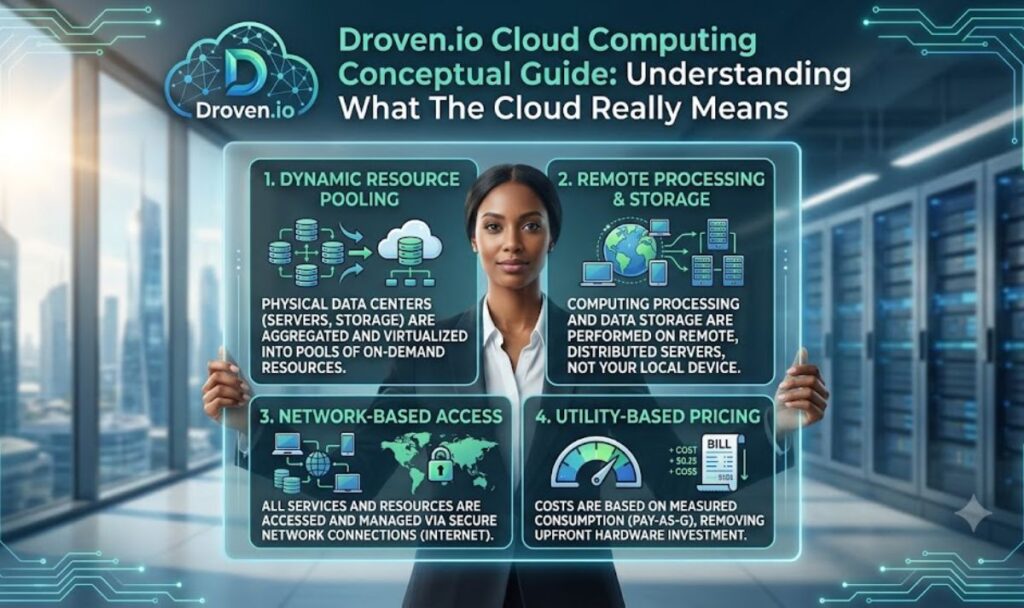
Cloud computing is the delivery of computing resources — servers, storage, databases, networking, and software — over the internet instead of through physical, on-premise hardware. Rather than buying and maintaining servers in a back room, businesses rent capacity from a provider and pay only for what they use.
At its core, cloud computing solves three recurring business problems:
- Cost: no upfront investment in physical hardware
- Speed: new resources can be provisioned in minutes, not weeks
- Flexibility: capacity can scale up or down based on real demand
This shift from owning infrastructure to renting it is what makes cloud computing one of the defining technology trends of the past decade, and it continues to evolve heading into 2026.
What Is Droven.io and Why People Search for It
Droven.io is an independent, vendor-neutral content platform that publishes educational articles on emerging technology topics, including cloud computing, cybersecurity, AI, and automation. It does not sell software, cloud infrastructure, or consulting packages.
People search for Droven.io because it functions as a research layer — a place to understand a technology before committing budget or time to it. For cloud computing specifically, that means plain-language explanations of deployment models, features, and setup steps without a sales pitch attached. Think of it as a starting point for informed decisions, not a vendor comparison funnel.
Why Cloud Computing Matters More in 2026
Cloud adoption has moved past the early-adopter phase. In 2026, cloud infrastructure underpins everyday business tools — from customer relationship management systems to AI-powered analytics platforms. A few forces are driving continued growth:
- Remote and hybrid work require accessible, always-on systems
- AI workloads demand elastic compute power that on-premise hardware can’t easily match
- Data volumes keep growing, pushing storage needs beyond local capacity
- Competitive pressure rewards teams that can deploy and iterate quickly
Businesses that delay cloud adoption increasingly find themselves at an operational disadvantage compared to competitors already running lean, cloud-native systems.
The Main Cloud Computing Types
Cloud services are generally grouped into three categories, each offering a different level of control versus convenience.
Infrastructure as a Service (IaaS)
IaaS provides raw computing infrastructure — virtual machines, storage, and networking — over the internet. Businesses manage the operating system and applications themselves, while the provider handles the physical hardware. It’s the most flexible option and suits teams that need full control over their environment.
Platform as a Service (PaaS)
PaaS adds a development and deployment layer on top of infrastructure. Developers can build, test, and launch applications without worrying about underlying servers or operating systems. This model speeds up development cycles significantly.
Software as a Service (SaaS)
SaaS delivers fully built applications over the internet, accessed through a browser or app. Email platforms, CRM tools, and project management software are common examples. There’s no infrastructure or platform management involved — just usage.
| Model | Who Manages What | Best For |
| IaaS | You manage OS, apps, data; provider manages hardware | Teams needing full infrastructure control |
| PaaS | You manage apps and data; provider manages platform and OS | Developers building and deploying apps quickly |
| SaaS | Provider manages everything; you just use the app | End users needing ready-made software |
Cloud Deployment Models in the Real World
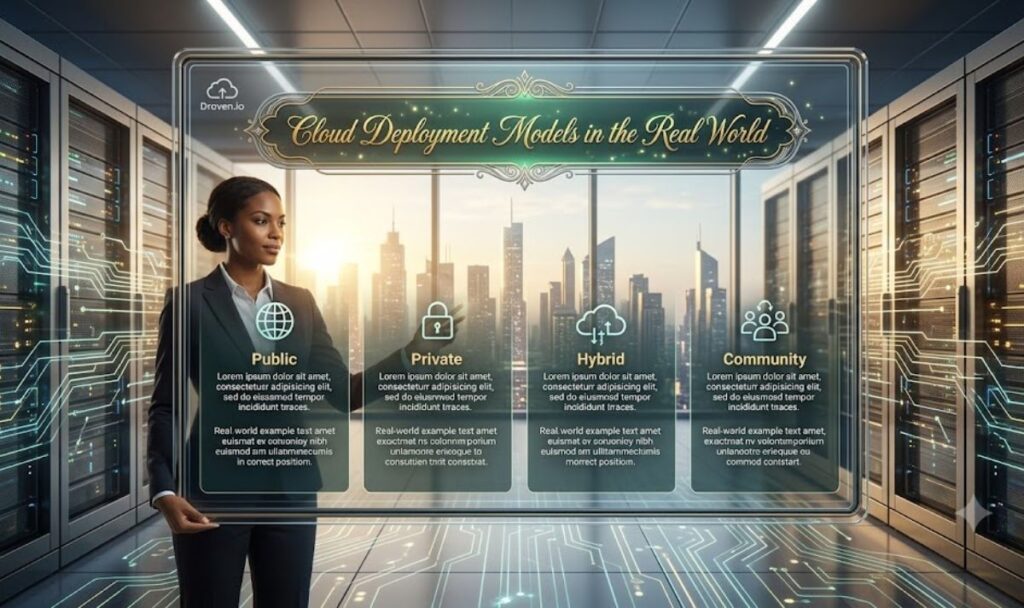
Beyond service types, cloud computing also comes in different deployment models depending on where and how resources are hosted.
Public Cloud
Resources are owned and operated by a third-party provider and shared across multiple customers. It’s cost-effective and scalable but offers less control over the underlying infrastructure.
Private Cloud
Infrastructure is dedicated to a single organization, either hosted on-site or by a third party. It offers more control and security but at a higher cost.
Hybrid Cloud
A combination of public and private cloud environments, allowing data and applications to move between the two. This model is popular for balancing cost efficiency with control over sensitive workloads.
Multi-Cloud
Using services from multiple cloud providers simultaneously, often to avoid vendor lock-in or to leverage the specific strengths of different platforms.
The Cloud Computing Features That Actually Matter
Not every feature listed on a provider’s homepage is equally important. These five consistently make the biggest operational difference.
Elastic Scalability
The ability to automatically increase or decrease resources based on demand, without manual intervention or downtime.
High Availability
Redundant systems and failover mechanisms that keep applications running even if one server or data center fails.
Automation
Automated deployment, scaling, and maintenance tasks reduce manual work and human error across the infrastructure.
Global Accessibility
Data centers distributed across regions allow businesses to serve users worldwide with lower latency.
Monitoring and Analytics
Built-in dashboards and alerting systems that track performance, usage, and potential issues in real time.
The Real Benefits of Cloud Computing
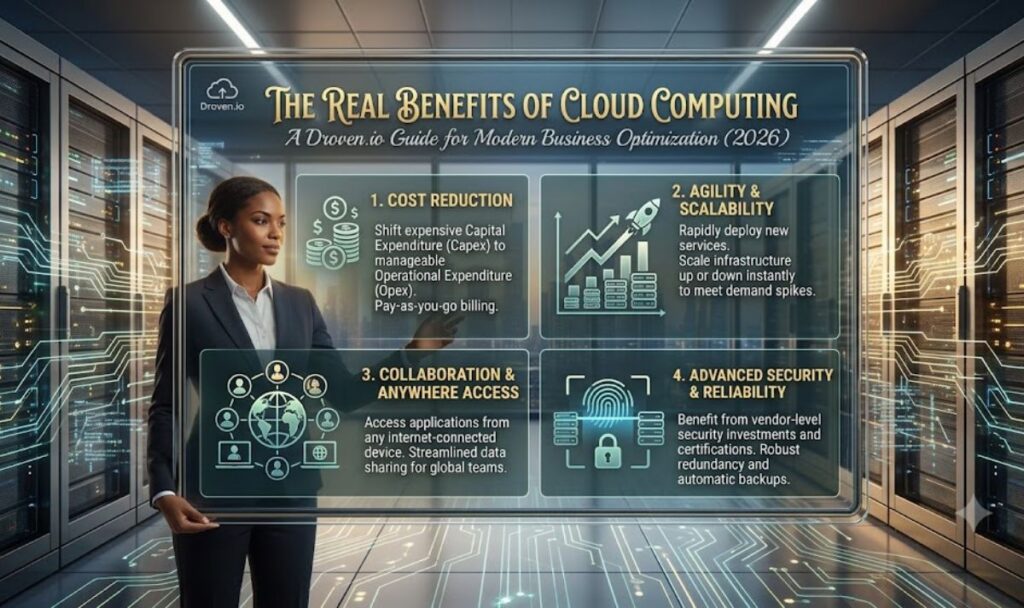
- Lower upfront costs — no need to purchase physical servers
- Faster deployment — new environments can be spun up in minutes
- Scalability on demand — pay for capacity as it’s needed, not in advance
- Improved collaboration — teams can access shared systems from anywhere
- Built-in disaster recovery — data backups and redundancy reduce data loss risk
- Automatic updates — providers handle patching and maintenance
Real-World Cloud Computing Examples
Cloud computing shows up in more everyday tools than most people realize:
- Streaming platforms use cloud storage and content delivery networks to serve video globally
- E-commerce sites rely on elastic scaling to handle traffic spikes during sales events
- Healthcare providers use cloud-based systems to securely store and share patient records
- Startups build entire products on cloud platforms without owning a single physical server
Droven.io Cloud Computing Guide: How to Set Up a Practical Cloud Environment
Setting up a cloud environment doesn’t need to be complicated if it’s approached step by step.
Step 1: Define Goals
Identify what the environment needs to support — a website, an application, data storage, or internal tools — before choosing services.
Step 2: Design Architecture
Map out how components (servers, databases, networking) will connect, and choose the appropriate service and deployment model.
Step 3: Configure Security
Set up firewalls, access controls, encryption, and identity management before deploying any live workloads.
Step 4: Deploy and Test
Launch the environment in a staging setup first, running tests to confirm performance and stability under expected load.
Step 5: Monitor and Optimize
Use monitoring tools to track usage patterns and adjust resources, costs, and configurations over time.
Managing Cost Without Losing Control
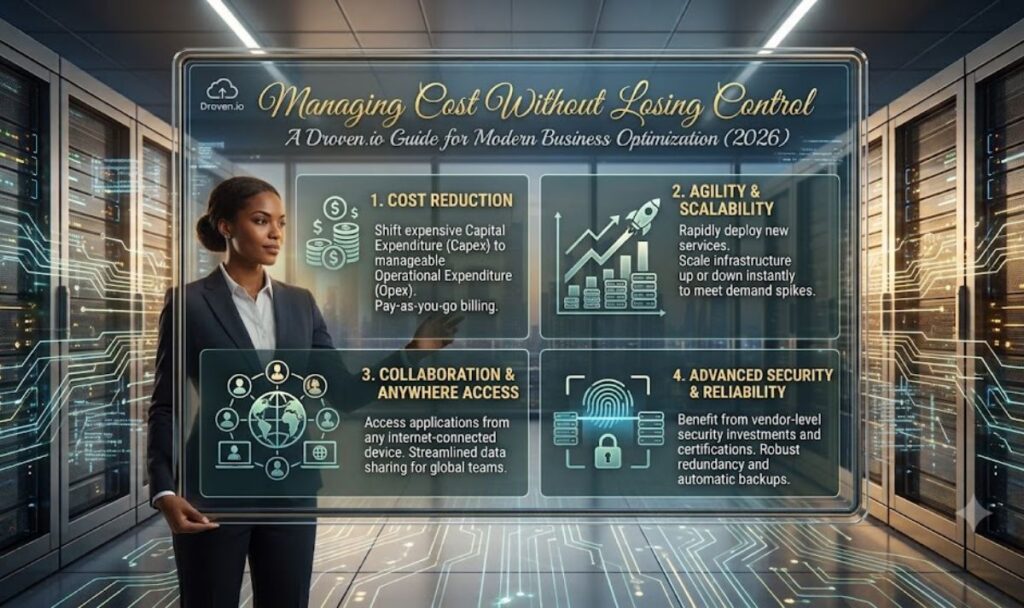
Cloud costs can spiral quickly without oversight. A few practical habits help keep spending in check:
- Set budget alerts and usage limits at the account level
- Regularly review and shut down unused resources
- Use reserved or committed-use pricing for predictable workloads
- Right-size instances instead of over-provisioning “just in case”
Security Risks That Still Catch Teams Off Guard
Even experienced teams make avoidable mistakes. Common risks include:
- Misconfigured storage buckets left publicly accessible
- Weak or reused access credentials
- Missing encryption on data in transit or at rest
- Overly broad permissions granted to users or applications
Common Mistakes New Cloud Users Make
- Migrating everything at once instead of in phases
- Ignoring cost monitoring until the first oversized bill arrives
- Skipping backup and disaster recovery planning
- Assuming the provider is responsible for all security (it’s usually shared)
Cloud Computing in 2026 and What Comes Next
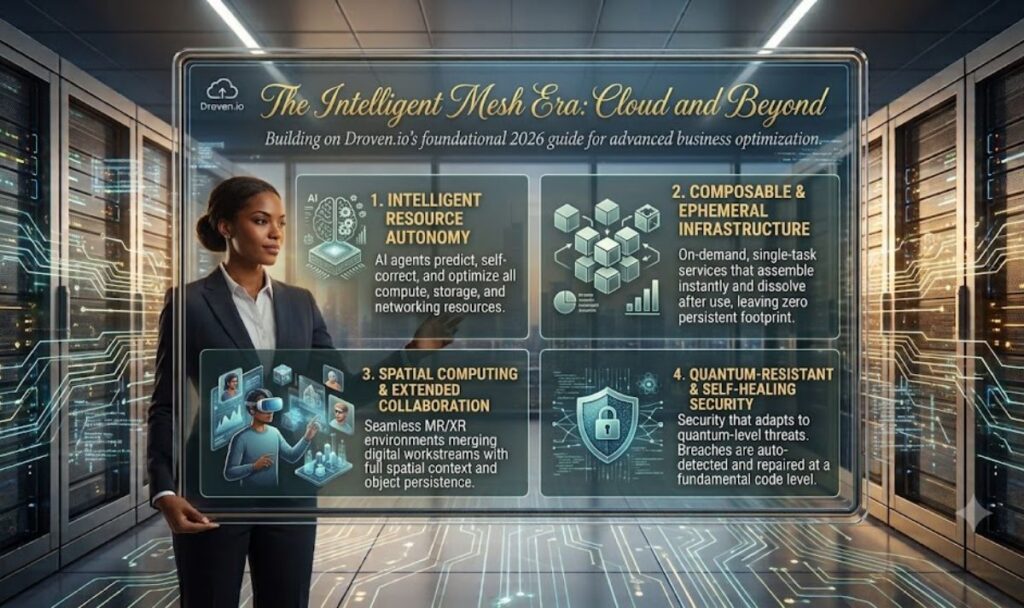
Cloud computing in 2026 is increasingly shaped by AI workloads, edge computing, and tighter integration between multi-cloud environments. Expect continued growth in serverless architectures, stronger automation around security compliance, and more businesses adopting hybrid setups that balance cost with control. The fundamentals — scalability, availability, and security — remain the same, but the tools supporting them keep getting smarter.
FAQ’s
What is cloud computing in simple terms?
It’s renting computing power, storage, and software over the internet instead of owning physical hardware.
Is Droven.io a cloud service provider?
No, Droven.io is an educational content platform; it explains cloud computing but doesn’t sell infrastructure or software.
What’s the difference between IaaS, PaaS, and SaaS?
IaaS gives raw infrastructure, PaaS adds a development platform, and SaaS delivers a ready-to-use application.
Which cloud deployment model is best for small businesses?
Public cloud is usually best for small businesses due to lower costs and easier setup.
How much does cloud computing cost?
Costs vary widely based on usage, but most providers offer pay-as-you-go pricing with no fixed upfront fee.
Is cloud computing secure?
It can be secure if configured correctly, but security is typically a shared responsibility between provider and user.
Conclusion
Cloud computing isn’t a passing trend, it’s the operational foundation most modern businesses now run on. Understanding the service types, deployment models, and setup steps covered in this Droven.io cloud computing guide gives you a solid, practical foundation for making smarter infrastructure decisions in 2026 and beyond. Start small, prioritize security, and scale as real demand grows.