If you have ever heard a Muslim friend or colleague say “Barakallahu Feek” after you helped them, offered a gift, or simply shared kind words, you have witnessed one of the most heartfelt expressions in the Arabic language.“May Allah bless you” is not a throwaway phrase, it is a genuine prayer, a small act of worship wrapped inside everyday conversation.
This phrase carries centuries of spiritual meaning, cultural nuance, and grammatical detail that many people never learn. Whether you want to use it correctly with a male or female friend, understand how to respond when someone says it to you, or simply learn the beauty behind the words, this guide covers everything in one place.
By the end of this article, you will know exactly how to say, spell, pronounce, and respond to “May Allah bless you” in Arabic and why this small phrase means so much in Islamic culture.
Understanding the Meaning Behind “May Allah Bless You in Arabic”
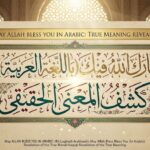
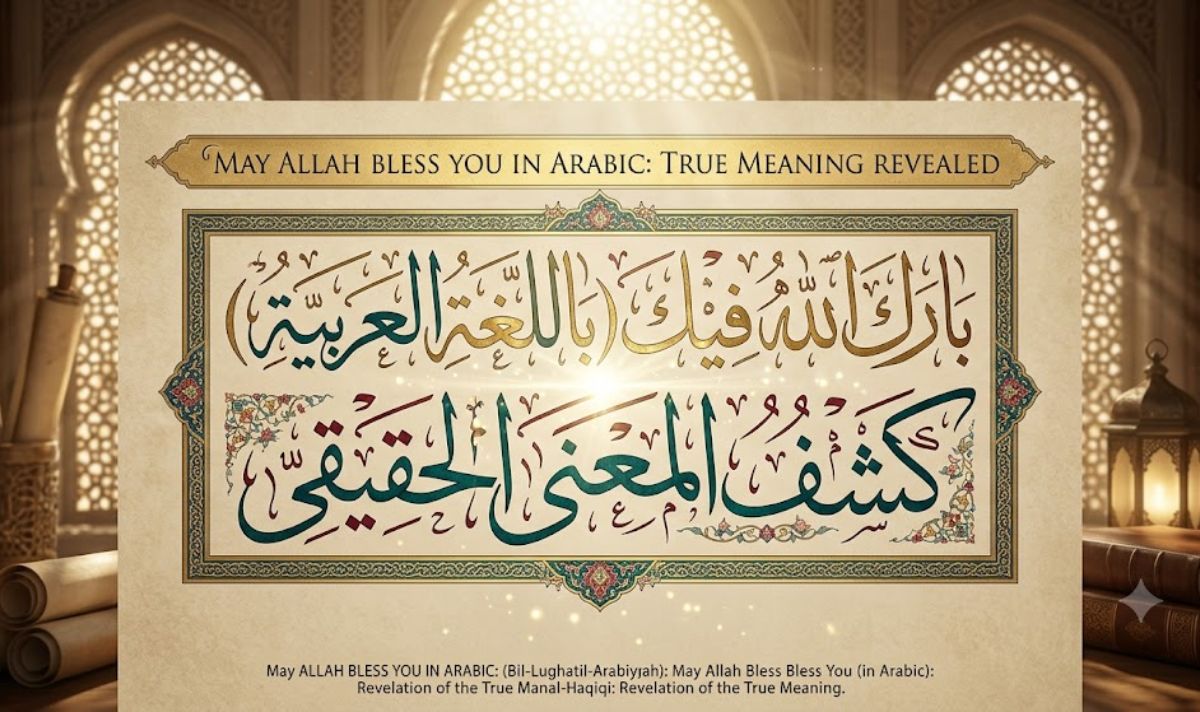
At its core, “May Allah bless you” in Arabic is most commonly written as بارك الله فيك and pronounced “Barakallahu Feek” (for a male) or “Barakallahu Feeki” (for a female).
Breaking the phrase down word by word helps reveal its depth:
- Barak (بارك) — comes from the root word for “blessing” or “increase,” meaning to bless or to grant abundance.
- Allahu (الله) — the Arabic word for God.
- Feek / Feeki (فيك / فيكِ) — meaning “in you,” directed at a specific person.
Put together, the phrase literally translates to “May Allah place blessing in you.” It is not simply a polite phrase like “thank you.” It is a direct supplication — a prayer asking God Himself to grant someone goodness, protection, and abundance in their life.
This is why the phrase feels so different from a casual “well done” or “thanks.” When someone says it to you, they are not just acknowledging you — they are asking a higher power to reward you.
Why This Phrase Feels So Personal
Unlike generic compliments, this expression connects the speaker, the listener, and the divine all in one sentence. That is part of why it is used so widely across Muslim communities worldwide, regardless of native language or country.
A Quick Snapshot Before You Read On
If you only have a minute, here is the essence of everything this guide covers:
| Question | Quick Answer |
| How do you say “May Allah bless you” in Arabic? | بارك الله فيك — Barakallahu Feek |
| How do you say it to a woman? | بارك الله فيكِ — Barakallahu Feeki |
| How do you respond to it? | وفيك بارك الله — Wa Feeka Barakallah |
| What does it literally mean? | “May Allah place blessing in you” |
| Is it religious or just polite? | It is a religious supplication (dua), not just a courtesy phrase |
Keep this table in mind as a reference point, then continue reading for the full explanation behind each answer.
What Does “May Allah Bless You” Mean in Islam?
In Islamic teaching, blessings (or barakah) are viewed as a divine gift that increases the goodness in something, even if that thing appears small. A blessed meal satisfies more than its size suggests. A blessed relationship grows stronger over time. A blessed effort produces results beyond what hard work alone could achieve.
When a Muslim says “May Allah bless you,” they are invoking this concept directly. They are essentially saying:
“I am asking Allah to place barakah in your life — in your health, your family, your work, and your time.”
This phrase is rooted in the Quran and Hadith, where blessings are frequently mentioned as something that comes only from Allah, not from human effort alone. Because of this spiritual foundation, saying “Barakallahu Feek” is considered an act of dua (supplication) rather than a simple compliment.
Key Islamic Principles Behind the Phrase
- Blessings are believed to come exclusively from Allah, not luck or chance.
- Saying this phrase to someone is considered a good deed for the speaker as well.
- It reflects humility, since the person is not taking credit but redirecting gratitude toward God.
- It reinforces the Islamic belief that words carry spiritual weight and should be chosen carefully.
Related Terms You Should Know
Understanding a few related Arabic and Islamic terms helps put “Barakallahu Feek” into fuller context:
- Barakah (بركة) — the noun form meaning “blessing” or “abundance,” the root concept behind the entire phrase.
- Dua (دعاء) — a personal supplication or prayer directed to Allah, of which “Barakallahu Feek” is one example.
- Khair (خير) — meaning “goodness,” frequently paired with blessings, as in “Jazak Allahu Khairan.”
- Rahmah (رحمة) — meaning “mercy,” closely linked to blessings such as “Yarhamuk Allah.”
These terms appear repeatedly across Islamic vocabulary because they all describe different dimensions of the same idea: goodness that originates from God and is passed between people through sincere words.
The Power of Blessings in Arabic and Islamic Culture
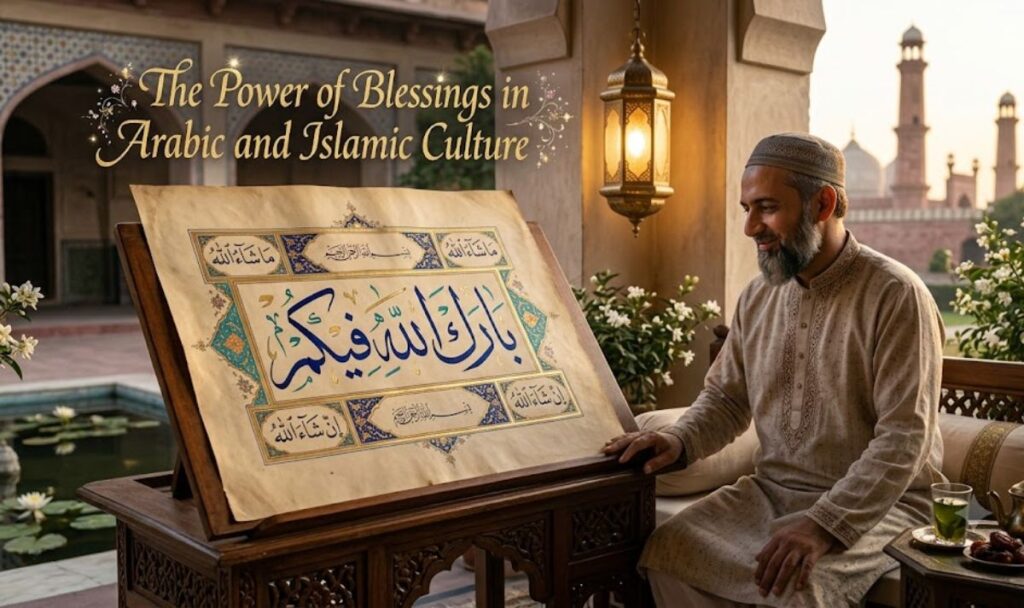
Arabic is often described as a language built for expressing deep emotion in few words, and blessings are one of the clearest examples of this. In Islamic culture, blessing someone is far more than good manners — it is considered a way of spreading goodness and strengthening the bond between people.
This is why blessings appear constantly in daily Muslim life:
- At the birth of a child
- During weddings and engagements
- After acts of kindness or generosity
- Before starting a meal or a journey
- When congratulating someone on new success
- After sneezing, as a form of care for one’s health
The repetition of these phrases throughout the day is intentional. Islamic teaching encourages believers to remain in a constant state of gratitude and remembrance of God, and blessings act as small, frequent reminders of that mindset.
Barakah as a Concept, Not Just a Word
Many scholars describe barakah as an invisible increase — something that cannot always be measured but can be felt. A small income that somehow covers every need. A short visit that leaves a lasting, positive impact. This is the deeper cultural weight behind phrases like “Barakallahu Feek.”
Everyday Examples of Barakah in Action
To understand how deeply this concept is woven into daily life, consider these common examples Muslims often describe as barakah:
- A modest meal that satisfies an entire family with room to spare.
- A short amount of study time that somehow leads to a strong exam result.
- A small business that grows steadily despite limited advertising or resources.
- A brief conversation with an elder that provides guidance felt for years afterward.
- A home that always seems to have room for one more guest, no matter how full it already is.
None of these outcomes can be measured with a formula, which is exactly why barakah is described as a spiritual, rather than purely logical, kind of increase. This belief is precisely why blessings are spoken so frequently — each phrase is essentially a small request for this unseen increase to enter someone’s life.
Common Arabic Phrases for “God Bless You” and Their Meanings
There is no single way to say “God bless you” in Arabic. Different phrases are used depending on the situation, formality, and relationship between speakers. Below is a breakdown of the most common expressions.
| Arabic Phrase | Transliteration | Literal Meaning | Common Use |
| بارك الله فيك | Barakallahu Feek | May Allah bless you | General blessing, gratitude, kindness |
| الله يبارك فيك | Allah Yubarik Feek | May Allah bless you (alternate form) | Everyday conversation, informal settings |
| جزاك الله خيراً | Jazak Allahu Khairan | May Allah reward you with goodness | After receiving help or a favor |
| يرحمك الله | Yarhamuk Allah | May Allah have mercy on you | Said after someone sneezes |
| بارك الله لك | Barakallahu Lak | May Allah bless you (for you) | Weddings, new beginnings |
| ما شاء الله | Mashallah | What Allah has willed | Admiration, praise, avoiding envy |
| بارك الله عملك | Baraka Allahu ‘Amalak | May Allah bless your work/effort | Congratulating achievement or effort |
Each of these carries a slightly different emphasis, but all of them share the same foundation: attributing goodness to Allah rather than chance or human effort alone.
The Difference Between “Feek” and “Lak”
Both “Feek” and “Lak” attach to “Barakallahu” but carry a subtle difference. “Feek” places the blessing inside the person, while “Lak” directs the blessing toward something belonging to them, such as a new home, a marriage, or a project. This is why “Barakallahu Lak” is especially common at weddings.
How to Say “God Bless You” in Arabic the Right Way?
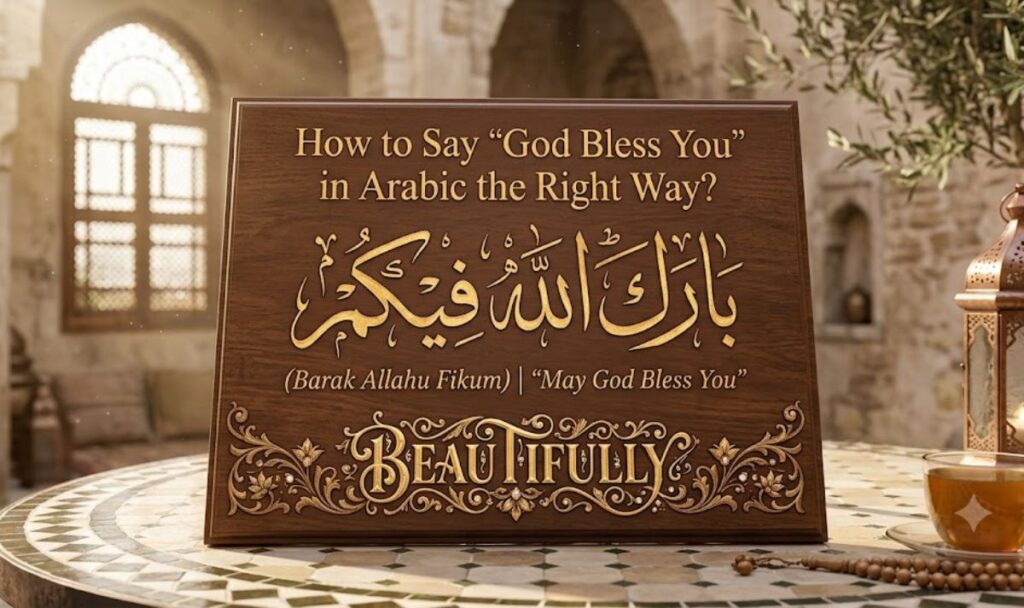
Saying this phrase correctly involves more than memorizing one version. Pronunciation, tone, and context all matter.
Here is a simple step-by-step approach:
- Identify who you are speaking to. Arabic grammar changes based on gender and number, so the ending of the phrase will shift depending on whether you are speaking to one man, one woman, or a group.
- Choose the right level of formality. “Barakallahu Feek” works in almost every setting, while phrases like “Bāraka Allahu ʻamalaka” are more formal and are used in Modern Standard Arabic or religious contexts.
- Say it with sincerity, not just habit. Since the phrase is considered a prayer, tone matters. It should be said warmly, not rushed or mumbled.
- Pair it with eye contact or a smile, especially in in-person interactions, since the phrase is meant to convey genuine goodwill.
Pronunciation Tips for Non-Native Speakers
- Break the phrase into syllables: Ba-ra-kal-la-hu Feek.
- The “kh” sound in words like “Khairan” comes from the back of the throat, similar to clearing your throat gently.
- Practicing with audio recordings or native speakers will help you avoid flattening the vowel sounds, which changes the rhythm of the phrase.
Syllable Breakdown Table
| Word | Syllables | Notes |
| Barakallahu | Ba-ra-ka-lla-hu | Stress falls gently on “ka” |
| Feek | Feek (one syllable) | Long “ee” sound, said to a male |
| Feeki | Fee-ki | Slightly softer ending, said to a female |
| Khairan | Khai-ran | “Kh” is a throat sound, not an English “k” |
Learning Arabic phrases by ear rather than only by reading transliterations tends to produce far more natural pronunciation, since written English letters cannot fully capture Arabic sounds like the guttural “kh” or the emphatic “ba.”
How to Use “May Allah Bless You” Correctly: Gender, Plural, and Grammar Rules?
Arabic is a gendered language, meaning verbs, adjectives, and pronouns often change depending on who is being addressed. This applies directly to blessings.
| Addressing | Arabic | Transliteration |
| One male | بارك الله فيكَ | Barakallahu Feeka |
| One female | بارك الله فيكِ | Barakallahu Feeki |
| Two people (dual) | بارك الله فيكما | Barakallahu Feekuma |
| Group of males/mixed group | بارك الله فيكم | Barakallahu Feekum |
| Group of females | بارك الله فيكن | Barakallahu Feekunna |
Common Mistakes to Avoid
- Using the male form (“Feek”) when speaking to a woman — the correct form is “Feeki.”
- Using singular forms when addressing a group instead of switching to “Feekum” or “Feekunna.”
- Forgetting that written Arabic often drops short vowel marks, so pronunciation must be learned by ear rather than by reading alone.
Getting these details right shows respect for the language and for Islamic etiquette, especially in formal or religious settings.
Why Grammar Accuracy Matters Here
Some people assume that grammar mistakes in a blessing are harmless since the intention is good. While sincerity always matters most, using the correct gendered or plural form shows attentiveness and respect toward the person you are addressing. In more traditional or religious circles, elders and teachers may gently correct these mistakes, not out of criticism, but to help preserve the accuracy of the language, since Arabic carries such close ties to the Quran and Islamic scholarship.
If you are unsure which form to use, it is completely acceptable to ask a native speaker directly. Most people appreciate the effort to get it right rather than expecting perfection on the first try.
How to Respond When Someone Says “May Allah Bless You” in Arabic?
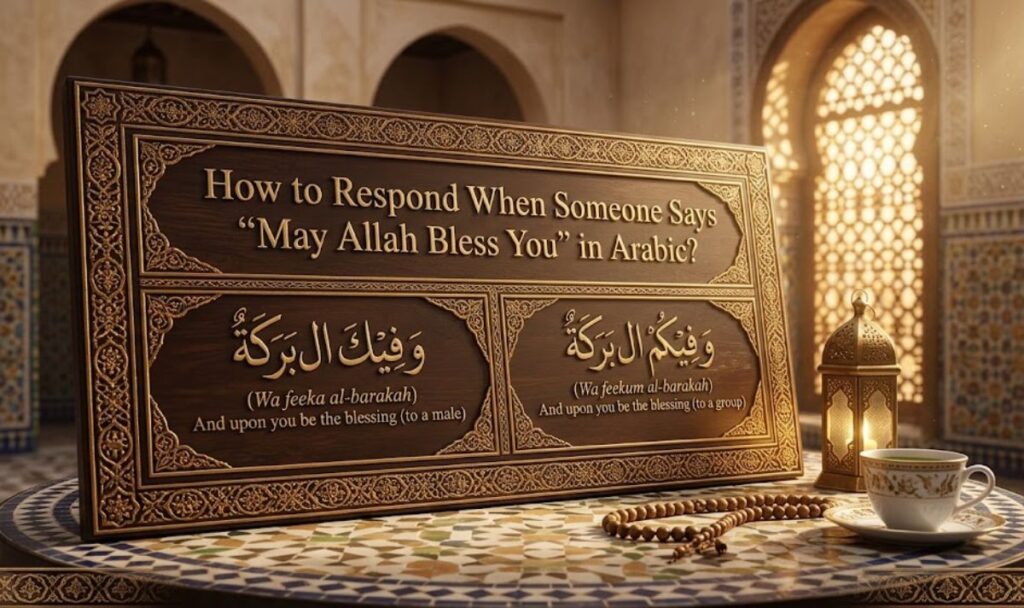
Because “Barakallahu Feek” is a prayer, Islamic etiquette encourages returning the blessing rather than simply saying “thank you.” Responding with a plain “thanks” is considered acceptable in casual contexts, but a proper Islamic response mirrors the dua back to the speaker.
Here are the most common and appropriate responses:
- Wa Feeka Barakallah (وفيك بارك الله) — “And may Allah bless you too.” This is the most direct and widely recommended reply, mirroring the original phrase.
- Wa Iyyak / Wa Iyyaki (وإياك / وإياكِ) — “And to you as well.” A shorter, equally acceptable response.
- Ameen, Wa Feeka Barakallah — Adding “Ameen” first acknowledges the prayer before returning it.
A Simple Response Guide
| If Someone Says | You Can Reply With |
| Barakallahu Feek | Wa Feeka Barakallah |
| Jazak Allahu Khairan | Wa Iyyak, Barakallahu Feek |
| Barakallahu Feeki (to a woman) | Wa Feeki Barakallah |
Avoiding a plain “thanks” in response to a religious phrase is considered good etiquette among many practicing Muslims, since it keeps the exchange as a mutual prayer rather than turning it into a simple social transaction.
Why “Just Saying Thanks” Falls Short
In many Western languages, a simple “thank you” completes a polite exchange. In Islamic etiquette, however, a blessing is treated as a gift of prayer, and prayers are ideally returned with prayers of equal or greater value. Responding to “Barakallahu Feek” with only “thanks” is not considered rude, but it is seen as missing an easy opportunity to multiply good deeds for both people involved.
This is part of a broader Islamic principle: when someone greets you with peace, tradition encourages returning that greeting with something equal or better. The same spirit applies to blessings — matching sincerity with sincerity.
Regional Variations: How “May Allah Bless You” Differs Across the Arab World
While Modern Standard Arabic phrases are understood everywhere, everyday spoken dialects vary from country to country. Here is how the phrase and its usage can shift regionally.
| Region | Common Variation | Notes |
| Gulf countries (Saudi Arabia, UAE, Kuwait) | Barak Allahu Feek | Very formal tone, widely used in daily speech |
| Egypt | Rabbena yebarek feek | “Rabbena” (our Lord) replaces “Allah” in casual speech |
| Levant (Syria, Lebanon, Jordan, Palestine) | Allah ybarek feek | Softer pronunciation, common in everyday chats |
| North Africa (Morocco, Algeria, Tunisia) | Allah ybarek | Shorter form, often blended with French or Berber influence in casual speech |
Why These Differences Exist
Spoken Arabic dialects developed independently across regions while still drawing from the same classical roots. This means the underlying meaning of blessing someone remains identical everywhere, even though pronunciation, word order, and word choice differ slightly.
Traveling or Chatting Online? Match the Dialect
If you are messaging a friend from a specific country, using their regional variation can make your words feel more natural and personal. For example:
- Writing to an Egyptian friend, “Rabbena yebarek feek” will sound more familiar than the formal Gulf version.
- Speaking with a Moroccan colleague, a shortened “Allah ybarek” fits the casual tone of everyday Darija conversation.
- In business or religious settings anywhere in the Arab world, the formal Modern Standard Arabic version, “Barakallahu Feek,” is always understood and considered respectful.
When in doubt, the classical Modern Standard Arabic form is a safe choice, since it is taught in schools across the Arab world and understood regardless of local dialect.
When and How to Use “May Allah Bless You” in Conversations?
Knowing the meaning is only half the picture — using it naturally in daily conversation is what makes the phrase feel authentic rather than memorized.
Common situations where this phrase fits naturally include:
- Thanking someone for a favor or gift
- Congratulating someone on a new job, marriage, or child
- Responding to someone’s kindness or generosity
- Wishing someone well before a trip or major life event
- Complimenting someone’s work, effort, or character
- Comforting someone during a difficult time
Everyday Example Scenarios
- A coworker helps you finish a report before a deadline — you say “Barakallahu Feek” to thank them.
- A friend invites you to their home for dinner — you thank the host with the same phrase as you leave.
- Someone compliments your child’s manners — you might respond with “Barakallahu Feek” to redirect the compliment toward gratitude to God.
- A neighbor lends you a tool or ingredient you were missing — a quick “Barakallahu Feek” acknowledges the favor warmly.
- A teacher explains a difficult topic clearly — students often thank instructors this way after a lesson or lecture.
- Someone shares comforting words during a hard time — replying with a blessing shows that their support was meaningful.
Used naturally and sincerely, this phrase becomes part of everyday speech rather than a phrase reserved only for formal occasions. Over time, many people find that saying it becomes second nature, replacing generic “thanks” almost entirely in conversations with fellow Muslims.
Expressing Gratitude and Well-Wishes in Arabic
Gratitude holds a central place in Islamic teaching, and Arabic offers many expressions beyond “Barakallahu Feek” to convey thankfulness and well-wishing.
Some additional expressions worth knowing:
- Shukran Jazeelan (شكراً جزيلاً) — “Thank you very much,” a more general, non-religious way to say thanks.
- Jazak Allahu Khairan Kathiran — “May Allah reward you abundantly with goodness,” an intensified version of a common thank-you phrase.
- Allah Ma’ak (الله معك) — “God be with you,” often used before someone leaves on a trip or faces a challenge.
These phrases are frequently combined in real conversation. For instance, someone might say “Shukran, jazak Allahu khairan” to combine a casual thank-you with a spiritual one.
The Deeper Meaning of “God Be With You” and “Bless You” in Arabic
“God be with you” and “bless you” are sometimes used interchangeably in English, but in Arabic, they carry distinct meanings.
- “Allah Ma’ak” (God be with you) focuses on protection and companionship — a wish that God accompanies someone through a journey, challenge, or transition.
- “Barakallahu Feek” (Bless you) focuses on abundance and increase — a wish that God multiplies goodness within someone’s life, work, or character.
Both phrases stem from the same spiritual worldview: that human effort alone is not enough, and true success or safety comes through divine support.
When to Use Each Phrase
| Situation | Best Phrase |
| Someone is leaving on a trip | Allah Ma’ak / Ma’aki |
| Someone helped you or gave a gift | Barakallahu Feek |
| Someone is going through hardship | Allah Ma’ak |
| Someone achieved success | Barakallahu Feek |
The Spiritual Rewards of Blessing Others in Islam
Islamic teaching places significant value on the act of blessing others, viewing it as a form of charity through speech. Since not everyone has the means to give money or gifts, kind and sincere words are considered accessible acts of goodness available to everyone.
Key spiritual principles connected to this include:
- Speaking well of others is considered a form of worship.
- Making dua for someone in their absence is believed to bring reward to the person praying, sometimes even more than praying for oneself.
- Consistently blessing others is thought to soften the heart and increase humility.
A Two-Way Blessing
One of the most meaningful aspects of saying “Barakallahu Feek” is that both parties benefit spiritually — the person saying it earns reward for their sincerity, and the person receiving it is uplifted by the prayer made on their behalf. This mutual benefit is part of why the phrase is repeated so often throughout Muslim communities.
How Arabic Blessings Strengthen Faith and Community Bonds?
Blessings are not only personal — they play a communal role in strengthening relationships and faith within Muslim communities.
Here is how they contribute to stronger bonds:
- Reinforcing shared values. Repeating blessings regularly reminds community members of shared beliefs about gratitude and humility.
- Reducing tension. Responding to conflict or disagreement with a blessing rather than a sharp word can defuse tension and preserve relationships.
- Creating a culture of encouragement. Frequent blessings during achievements, both big and small, build a supportive social environment.
- Passing tradition to children. Teaching children to say and respond to these phrases keeps the tradition alive across generations.
In many households, children are taught from a young age to say phrases like “Yarhamuk Allah” after someone sneezes or “Barakallahu Feek” after receiving something, embedding these values early in life.
Blessings as Social Glue
Sociologists studying religious communities often note that shared verbal rituals — phrases repeated consistently across a group — help build a sense of belonging. In Muslim communities, blessings function exactly this way. A newcomer who learns to say “Barakallahu Feek” naturally and use it correctly often feels more quickly welcomed into the social fabric of the community, since the phrase signals shared values and mutual respect.
Happy Birthday May Allah Bless You: Arabic Birthday Blessings
Birthdays are celebrated differently across Muslim communities, but when they are acknowledged, blessings often replace or accompany typical birthday wishes.
Common Arabic birthday blessings include:
- “Kul ‘aam wa anta bikhair” (كل عام وأنت بخير) — “May you be well every year,” a traditional way to mark a birthday or anniversary.
- “Barakallahu Feek fi hayatik” (بارك الله فيك في حياتك) — “May Allah bless you throughout your life.”
- “Allah yatawwil ‘umrak fi ta’ah” (الله يطول عمرك في طاعته) — “May Allah extend your life in obedience to Him,” a spiritually focused birthday wish.
Sample Birthday Message Combining Both Traditions
“Happy birthday! Kul ‘aam wa anta bikhair, and Barakallahu Feek — may this new year of your life be filled with health, happiness, and closeness to Allah.”
This style of message blends a warm, celebratory tone with a sincere spiritual wish, making it appropriate for both close friends and extended family.
May Allah Bless You with Endless Happiness and Success
This extended version of the phrase is often used in more heartfelt or written messages, such as cards, letters, or social media posts. It expands the simple blessing into a fuller wish for someone’s life.
Examples of extended blessings include:
- “May Allah bless you with endless happiness, good health, and lasting success.”
- “May Allah surround you with peace, protect your family, and bless every step you take.”
- “May Allah bless your efforts and multiply your reward in this life and the next.”
These longer versions are especially popular for:
- Graduation announcements
- Wedding congratulations
- New job or business milestones
- Recovery from illness
Because Arabic naturally lends itself to poetic, layered expressions, these extended blessings often feel more like short prayers than simple congratulations.
May Allah Bless You Quotes to Share with Loved Ones
Sharing a written blessing is a meaningful way to express care, especially through messages, cards, or social media posts. Below are original, inspired examples you can use or adapt:
- “May Allah bless you with a heart full of gratitude and a life full of ease.”
- “May Allah bless your journey, guide your steps, and grant you peace along the way.”
- “May Allah bless you today and always, in this life and the next.”
- “May Allah bless your hands that give, your heart that cares, and your soul that believes.”
- “May Allah bless you with patience in hardship and gratitude in ease.”
- “May Allah bless your family, protect your home, and increase your blessings.”
- “May Allah bless you with knowledge that benefits and a heart that remains humble.”
- “May Allah bless every effort you make and reward you beyond what you expect.”
- “May Allah bless you with strength for every challenge and gratitude for every blessing.”
- “May Allah bless you with a life where faith and happiness walk hand in hand.”
These quotes work well shared privately with a friend, written in a card, or posted alongside a photo to mark a special occasion.
Tips for Choosing the Right Quote
- For a close friend, choose something personal and specific to their situation, such as a new job or recovery from illness.
- For a wider audience, such as a social media caption, a shorter and more universal quote tends to resonate best.
- Pairing an English quote with its Arabic version, such as “بارك الله فيك,” adds authenticity and depth for readers familiar with the language.
FAQs
What does “Barakallahu Feek” mean?
It means “May Allah bless you,” literally translating to “May Allah place blessing in you.” It is used to express gratitude, admiration, or well-wishes.
Is “Barakallahu Feek” only used by Muslims?
While it is rooted in Islamic tradition, non-Muslims interacting with Muslim friends or colleagues often use it respectfully once they understand its meaning.
What is the difference between “Feek” and “Feeki”?
“Feek” is used when addressing a male, while “Feeki” is used when addressing a female. Both mean “in you.”
How do I respond to “Barakallahu Feek”?
The most appropriate response is “Wa Feeka Barakallah,” meaning “And may Allah bless you too.”
Can I say “Barakallahu Feek” to a non-Muslim?
Yes, it is generally acceptable, since it expresses a kind and respectful wish, though the person may not fully understand the phrase’s religious depth.
What is the plural form of “Barakallahu Feek”?
For a group, the correct form is “Barakallahu Feekum” (mixed or male group) or “Barakallahu Feekunna” (all-female group).
Is it wrong to just say “thank you” instead of returning the blessing?
It is not wrong, but returning the blessing with “Wa Feeka Barakallah” is considered more complete and spiritually meaningful within Islamic etiquette.
What does “Allah Yubarik Feek” mean?
It carries the same meaning as “Barakallahu Feek” — “May Allah bless you” — and is simply an alternate grammatical form used in casual speech.
Is there a difference between “Barakallahu Feek” and “Barakallahu Lak”?
Yes, “Feek” places the blessing inside the person, while “Lak” directs the blessing toward something belonging to them, such as a marriage or new home.
Can “May Allah bless you” be used for birthdays?
Yes, it is commonly paired with traditional Arabic birthday wishes like “Kul ‘aam wa anta bikhair” to add a spiritual dimension to the celebration.
Conclusion
“May Allah bless you“ in Arabic is far more than a polite phrase; it is a sincere prayer rooted in centuries of Islamic tradition, language, and culture. From its literal meaning of placing blessing within someone, to its many regional variations, grammatical rules, and heartfelt uses in birthdays and everyday gratitude, this expression carries a depth that few phrases in any language can match.
Whether you are learning to say it correctly, wondering how to respond, or simply looking for the right words to bless someone you care about, understanding “Barakallahu Feek” connects you to a tradition built on gratitude, humility, and genuine goodwill. The next time you hear or say this phrase, you will know it carries a meaning far greater than words alone, a true prayer for someone’s happiness, protection, and success.