If you’ve come across the “12 Year St. Bridget Prayers” and wondered what they actually are, why they’re prayed for twelve years, and whether the Catholic Church recognizes them, you’re in the right place. This guide walks through everything the seven prayers themselves, the history behind them, the promises attached to the devotion, and honest, balanced answers about what the Church actually says.
This devotion has quietly circulated among Catholics for generations, passed down through prayer cards, parish bulletins, and word of mouth. It asks for something unusual in modern spiritual life: patience. Not a nine-day novena. Not a single Lenten season. Twelve years of daily prayer, centered entirely on the suffering of Jesus Christ.
Below, you’ll find the complete text and structure of the devotion, its origins with St. Bridget of Sweden, how to begin praying it today, and a clear-eyed look at the promises that make this devotion so widely discussed along with what the Church has and hasn’t approved.
Quick Summary Table
| Detail | Information |
| Devotion Name | The 12 Year Prayers of St. Bridget (Prayers on the Passion of Jesus) |
| Number of Prayers | 7 prayers, each preceded by an Our Father and a Hail Mary |
| Daily Time Required | Roughly 7–10 minutes |
| Total Duration | 12 years, prayed daily |
| Focus | The seven times Jesus shed His Precious Blood during His life and Passion |
| Origin | Revealed, according to tradition, to St. Bridget of Sweden in the 14th century |
| Related Devotion | The 15 Prayers of St. Bridget (a separate one-year devotion) |
| Promises Attached | 5 promises (12-year devotion) — not formally approved by the Church |
| Church Status | Prayers permitted for private devotion; attached promises are private revelation, not doctrine |
| Best For | Catholics and Christians seeking a long-term, disciplined prayer life centered on Christ’s Passion |
What Are the 12 Year St. Bridget Prayers?
The 12 Year St. Bridget Prayers are a Catholic devotion made up of seven short prayers, each meditating on a specific moment when Jesus Christ shed His blood — from His circumcision as an infant to the piercing of His side on the cross. Tradition holds that these prayers were revealed to St. Bridget of Sweden, a 14th-century mystic, with the instruction that they be recited daily for twelve consecutive years.
Unlike a novena or a nine-day devotion, this isn’t a short spiritual sprint. It’s a long, steady walk — a devotion built around consistency rather than intensity. Each day takes only a few minutes, but the commitment stretches across more than a decade.
What Is the 12-Year Prayer Devotion?
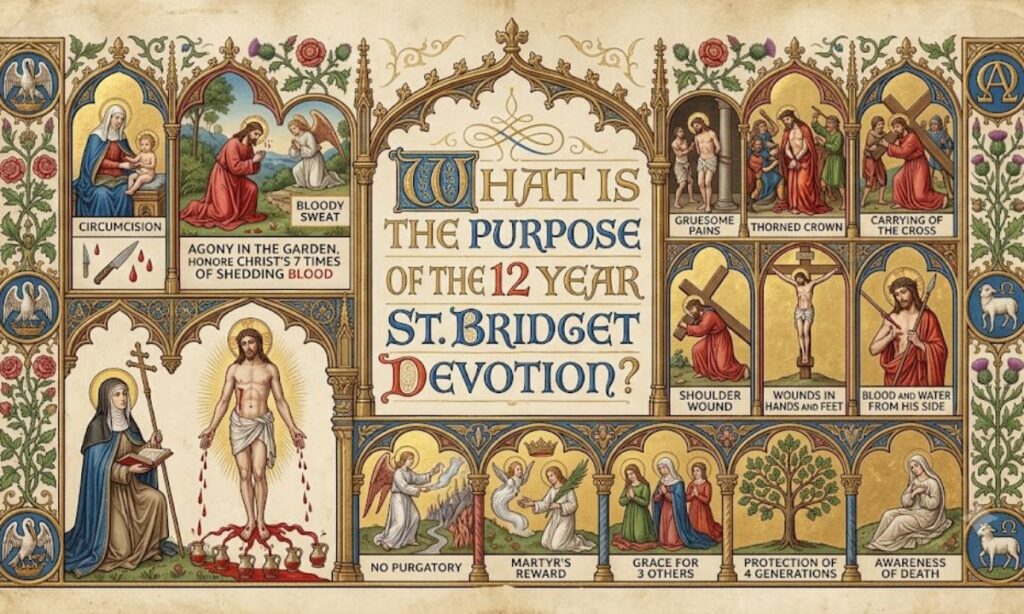
At its core, the devotion asks the person praying to recite seven specific prayers every single day, each one preceded by one Our Father and one Hail Mary, for twelve full years. Together, the seven prayers walk through the major moments of Christ’s suffering: His circumcision, His agony in the Garden of Gethsemane, His scourging, His crowning with thorns, His carrying of the cross, His crucifixion, and finally the piercing of His side.
The devotion isn’t meant to be rushed. It’s designed as a slow, repeated meditation — the same prayers, said daily, so that Christ’s Passion becomes a fixed part of someone’s spiritual rhythm rather than a once-a-year reflection during Lent.
Why Is It Called the 12-Year Prayer?
The devotion takes its name simply from its required length: twelve years of daily prayer. According to the tradition surrounding these prayers, this timeframe wasn’t arbitrary. It’s tied to the belief that faithful, sustained prayer over more than a decade honors the totality of Christ’s suffering in a way that a single prayer, or even a year of prayer, cannot.
Some sources tie the number twelve to its broader symbolic meaning in Scripture — the twelve apostles, the twelve tribes of Israel — representing fullness, completeness, and the entirety of the Church gathered around Christ.
What Makes This Devotion Unique?
Most Catholic devotions run for a set number of days: novenas last nine days, certain chaplets are prayed within a single sitting, and even the well-known 15 Prayers of St. Bridget only run for one year. The 12 Year Prayers stand apart because of their sheer duration.
A few things make it distinct:
- Longevity — Twelve years is far longer than almost any other popular Catholic devotion.
- Simplicity — Despite the long commitment, the daily prayer itself takes only minutes.
- Focus — Every prayer centers specifically on the shedding of Christ’s blood, not a broader theme.
- Structure — Each of the seven prayers is tied to a distinct historical moment in the Passion narrative.
The Complete 7 Prayers of the 12-Year Devotion
The devotion opens with an introductory prayer, followed by seven prayers, each preceded by one Our Father and one Hail Mary. The seven prayers correspond to these moments:
- First Prayer — The shedding of Christ’s blood at His Circumcision.
- Second Prayer — His agony and bloody sweat in the Garden of Gethsemane.
- Third Prayer — The scourging at the pillar.
- Fourth Prayer — The crowning with thorns.
- Fifth Prayer — The carrying of the cross to Calvary.
- Sixth Prayer — The nailing of His hands and feet to the cross.
- Seventh Prayer — The piercing of His side with a lance after His death.
Each prayer is a short meditation, typically a few sentences long, asking Christ to apply the merits of that particular suffering to the one praying and to the souls they carry in their heart. Because the full Latin-to-English texts vary slightly between prayer books and parishes, it’s best to use a verified prayer card or a trusted Catholic devotional source for the exact wording, rather than relying on a single website’s transcription.
Who Was St. Bridget of Sweden?
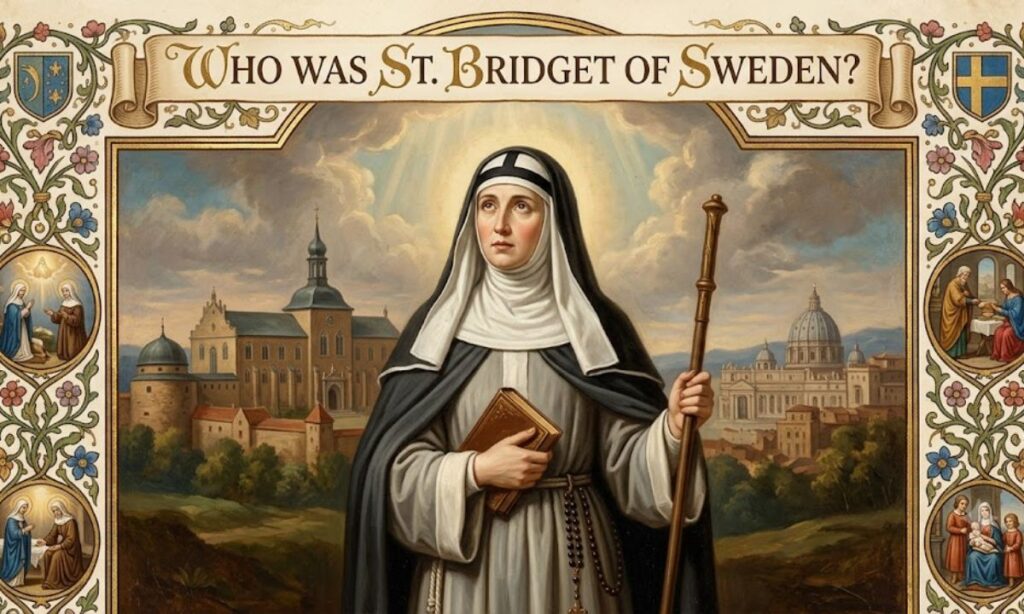
To understand the devotion, it helps to understand the woman behind it. St. Bridget of Sweden — also known as St. Birgitta — was a 14th-century noblewoman, wife, mother, mystic, and founder of a religious order. She remains one of the most influential female saints in Church history.
Early Life
St. Bridget was born around 1303 in Uppland, Sweden, into a wealthy and devoutly Catholic family. Her father, Birger Persson, was a provincial governor and one of the wealthiest landowners in the country. From childhood, Bridget showed an unusually strong pull toward prayer and religious devotion, something her family actively encouraged.
At the age of thirteen, she was married to Ulf Gudmarsson, a young nobleman. The couple went on to have eight children together, including a daughter, Catherine, who would later also be canonized as a saint. Bridget was known throughout her life for her charitable works, caring for the poor and the sick alongside her royal and noble responsibilities.
Her Mystical Visions
Bridget’s spiritual life was marked by visions and revelations that she believed came directly from Jesus Christ and the Virgin Mary. As a young child, she reportedly experienced a vivid vision of Christ crucified, an experience that shaped her devotion to the Passion for the rest of her life.
After her husband’s death in 1344, Bridget devoted herself even more fully to prayer and mysticism. She recorded hundreds of these revelations, which were later compiled into a work known as the Revelations of St. Bridget. It’s within this broader collection of visions and teachings that the tradition of both the 15 Prayers and the 12 Year Prayers on the Passion is rooted.
Canonization
St. Bridget died in Rome on July 23, 1373. Fewer than twenty years later, on October 7, 1391, Pope Boniface IX formally canonized her — a remarkably swift recognition of sainthood for the era. Her canonization was later reaffirmed by the Council of Constance in 1415 and the Council of Basel in 1436.
Legacy in Christianity
St. Bridget founded the Order of the Most Holy Savior, commonly known as the Bridgettines, which continues to exist today with communities around the world. She is honored as the patron saint of Sweden and of widows, and in 1999, Pope John Paul II named her a co-patroness of Europe, alongside St. Catherine of Siena and St. Teresa Benedicta of the Cross (Edith Stein).
Her feast day is celebrated on July 23 each year. Her legacy lives on not only through her religious order but through the prayers attributed to her, which continue to be prayed by Catholics worldwide more than 650 years after her death.
The History and Origin of the 12 Year St. Bridget Prayers
The story behind these prayers is rooted in tradition and private revelation rather than a single, universally documented historical event — which is an important distinction for anyone approaching this devotion with an informed, discerning mindset.
The Vision of Jesus Christ
According to the tradition that has been passed down, Christ appeared to St. Bridget and revealed that He had received 5,480 blows to His body during His Passion. Out of a desire to honor each of these wounds, Bridget reportedly asked Christ how she could properly venerate His suffering. In response, He is said to have given her a set of prayers to be recited daily — with the 12 Year Prayers focusing specifically on seven distinct moments of bloodshed throughout His life and death.
Historical Background
The prayers themselves first appeared in printed devotional booklets and prayer cards over the centuries following Bridget’s death, spreading gradually through convents, parishes, and Catholic households. Devotional literature from later centuries — including materials distributed by shrines and religious communities — describes the devotion as having received informal recommendation, with some accounts referencing endorsement connected to Pope Clement XII and confirmation from Pope Innocent X regarding the authenticity of the underlying revelation.
It’s worth noting that historical claims like these are difficult to verify with full certainty centuries later, and different sources sometimes present slightly different details about which popes were involved and in what capacity. Anyone researching the devotion closely should treat these historical claims as long-standing pious tradition rather than settled, documented fact.
How the Devotion Spread Around the World
Over the following centuries, the prayers spread through Catholic Europe and eventually to North America, largely through devotional prayer cards, parish bulletins, and small religious publishing houses. Shrines, traditional Catholic parishes, and online prayer communities have kept the devotion alive into the 21st century, with many people today discovering it through prayer card distribution ministries or Catholic devotional websites rather than through official Church channels.
What Are the 15 Prayers of St. Bridget?
Because the 15 Prayers and the 12 Year Prayers share the same origin story and are frequently confused with one another, it’s worth clarifying exactly how they differ.
Why There Are 15 Prayers
According to the same tradition, Christ told St. Bridget that He had received 5,480 blows during His Passion. He instructed her to pray 15 Our Fathers and 15 Hail Marys, along with 15 specific prayers, every day for one full year. Fifteen prayers said daily across 365 days comes remarkably close to honoring each of those 5,480 blows — a detail devotional writers have long pointed to as part of the prayer’s symbolic structure.
What Each Prayer Focuses On
Where the 12 Year Prayers concentrate on seven specific bloodshed events, the 15 Prayers move through a broader, more detailed meditation on the entire Passion — from the Last Supper and Christ’s agony in the garden, through His arrest, trial, scourging, crowning with thorns, carrying of the cross, crucifixion, death, and the wounds inflicted on His body. Each prayer is longer and more descriptive than the seven prayers of the 12-Year devotion.
Where to Find the Complete 15 Prayers
The full text of the 15 Prayers is widely available through Catholic prayer books, parish devotional pamphlets, and reputable Catholic prayer websites. Because the wording has been translated and reprinted many times since the original 1740 Toulouse printing, it’s best to source the prayers from a trusted Catholic publisher or parish resource to ensure accuracy.
| Feature | 12 Year Prayers | 15 Prayers |
| Number of Prayers | 7 | 15 |
| Duration | 12 years | 1 year |
| Focus | 7 moments of bloodshed | Full narrative of the Passion |
| Daily Time | ~7–10 minutes | ~10–15 minutes |
| Promises | 5 promises | 15 promises (varies by source) |
How to Pray the 12 Year St. Bridget Prayers
Starting the devotion doesn’t require any special permission or ceremony. It simply requires a decision to begin, along with a realistic plan for staying consistent over the years ahead.
Step-by-Step Daily Prayer Guide
- Find a quiet moment in your day, free from distractions.
- Begin with the Sign of the Cross.
- Pray the opening prayer of the devotion.
- Recite each of the seven prayers, preceded by one Our Father and one Hail Mary for each.
- Close with a moment of silent reflection or a closing prayer of gratitude.
- Note the date if you’re keeping a prayer journal, especially on your first day.
Best Time to Pray
Many people who practice this devotion choose to pray it first thing in the morning, before the demands of the day take over, or in the quiet hours of the evening before bed. There’s no official rule about timing — what matters most is consistency, not the specific hour.
Preparing Your Heart Before Prayer
Before beginning, take a few slow breaths and mentally set aside distractions. Some people find it helpful to briefly recall why they’re praying — for their own spiritual growth, for a loved one, or for someone in need of prayer. This short moment of intention-setting helps the prayers feel less like a checklist and more like genuine conversation with God.
Sample Daily Prayer Routine
| Time | Activity |
| Morning (5 minutes) | Sign of the Cross, opening prayer, first 3–4 prayers |
| Evening (5 minutes) | Remaining prayers, closing reflection |
Splitting the devotion into a morning and evening rhythm can make it easier to sustain over the long haul, especially for those with busy schedules.
How Long Do Daily Prayers Take?
Most people complete the full set of seven prayers, along with the accompanying Our Fathers and Hail Marys, in around 7 to 10 minutes. It’s a short daily commitment — the challenge lies not in the length of each session, but in maintaining it faithfully for twelve consecutive years.
Why Is the Devotion Prayed for 12 Years?
This is one of the most common questions people ask when they first encounter this devotion, and it deserves a thoughtful answer.
The Spiritual Meaning of the Number 12
The number twelve carries deep symbolic weight throughout Scripture and Christian tradition. It appears in the twelve tribes of Israel, the twelve apostles chosen by Christ, and the twelve gates of the New Jerusalem described in the Book of Revelation. In this context, twelve years is often understood as representing fullness and completeness — a spiritually “whole” period of dedication.
Is the 12-Year Commitment Mandatory?
No. Nothing about this devotion is mandatory in a strict sense — it isn’t a Church-mandated practice, a sacrament, or an obligation of the faith. It’s a private devotion, meaning it’s entirely voluntary. The twelve-year length reflects the tradition surrounding the prayer’s origin, not a rule imposed by the Church.
Can You Pray the Devotion for Less Than 12 Years?
Yes, absolutely. While the tradition specifies twelve years as the full length of the devotion tied to its associated promises, there is nothing stopping anyone from praying these beautiful prayers for a shorter period, or simply incorporating them into a broader daily prayer life without focusing on completing the full twelve-year cycle. The spiritual value of meditating on Christ’s Passion doesn’t disappear just because the full term isn’t completed.
What Is the Purpose of the 12 Year St. Bridget Devotion?
Beyond the promises and historical intrigue, the devotion serves a clear spiritual purpose: drawing the person praying into closer union with the suffering of Christ.
Meditating on Christ’s Passion
At its heart, this devotion is an extended meditation on the Passion — the physical and emotional suffering Christ endured for the redemption of humanity. Each of the seven prayers focuses attention on a different, specific moment of that suffering, encouraging a slow, repeated contemplation rather than a passing thought.
Growing Closer to Jesus
Daily repetition, over years rather than days, naturally deepens familiarity. Just as any relationship grows through consistent, sustained attention, many who pray this devotion describe feeling a gradual deepening of their relationship with Christ over the course of the twelve years.
Developing a Consistent Prayer Life
One of the quieter benefits of this devotion is the discipline it builds. Committing to a daily prayer practice — even one that only takes a few minutes — trains the habit of returning to prayer every single day, which can strengthen a person’s broader spiritual life well beyond the devotion itself.
Strengthening Faith Through Daily Devotion
Faith, like any commitment, tends to deepen through practice rather than passive belief alone. A twelve-year devotion offers a long runway for that kind of growth, giving the person praying years to notice how their faith responds to different seasons of life — joy, hardship, doubt, and renewal.
The 21 Promises of the 12 Year St. Bridget Prayers
This is one of the most searched — and most misunderstood — aspects of the devotion. It’s important to separate the different sets of promises tied to different Bridgettine devotions, since sources sometimes conflate them.
What Are the 21 Promises?
Some devotional sources reference a combined set of 21 promises tied to the broader body of Bridgettine prayers, drawing together the extraordinary graces associated with both the 12-Year devotion and the 15 Prayers. However, the most commonly cited and consistently repeated promises specific to the 12 Year devotion are five in number, traditionally listed as follows:
- The soul who prays them faithfully will not suffer the pains of Purgatory.
- The soul will be accepted among the martyrs, as though they had shed their own blood for the faith.
- The soul may choose three people from their family to be kept in a state of grace sufficient for their salvation.
- No one within four generations of the soul’s family line will be lost.
- The soul will be made aware of the date of their death one month in advance.
The number “21” that circulates online typically comes from websites combining these 5 promises with the separate list of 15 (or 16, depending on the source) promises attached to the one-year devotion of 15 Prayers.
What Do These Promises Mean?
Taken at face value, these promises describe extraordinary spiritual graces: freedom from purgatorial suffering, a share in the honor given to martyrs, spiritual protection extended to loved ones and future generations, and advance notice of one’s death so as to prepare properly. They reflect the medieval spiritual imagination in which physical suffering, intercession, and generational blessing were deeply intertwined themes.
Are the Promises Official Church Teaching?
No. This is a critical point that every source discussing this devotion should be transparent about. These promises are part of what’s known as private revelation — meaning they come from an individual’s reported mystical experience, not from the deposit of faith the Church formally teaches and defends. The Catholic Church has never formally approved these specific promises as guaranteed spiritual outcomes.
How Should Christians Understand These Promises?
The healthiest approach is to view the promises as pious tradition rather than doctrinal guarantee. The prayers themselves — meditations on Christ’s suffering — carry genuine spiritual value regardless of whether the attached promises are taken literally. Many spiritual directors encourage praying the devotion out of love for Christ and a desire to grow closer to Him, rather than treating it as a transaction where twelve years of prayer purchases a specific outcome.
Is the 12 Year St. Bridget Prayer Approved by the Catholic Church?
This is one of the most important questions to address honestly, and it deserves a clear, well-sourced answer.
What Does the Catholic Church Say?
The Catholic Church permits private devotions like the 12 Year Prayers as expressions of personal piety, so long as they don’t contradict Church teaching. The prayers themselves, as meditations on Christ’s Passion, are consistent with Catholic devotional practice. However, the Church has historically been cautious about the specific promises attached to Bridgettine prayer traditions.
In fact, regarding the closely related 15 Prayers devotion, the Holy Office issued a formal notice (a Monitum) in the 20th century cautioning that the source of the attached promises could not be verified as supernatural in origin, and instructing bishops not to grant permission for publishing materials that presented those promises as certain.
Public Revelation vs. Private Revelation
Catholic theology draws a firm distinction between public revelation — the deposit of faith completed with the death of the last apostle, which all Catholics are bound to believe — and private revelation, which includes reported visions, apparitions, and mystical experiences of individual saints and mystics. Even when the Church approves a private revelation as “worthy of belief,” Catholics are never required to believe it the way they are required to believe core doctrines like the Resurrection or the Trinity.
The 12 Year Prayers and their promises fall firmly into the category of private revelation.
Are Catholics Required to Pray This Devotion?
No. There is no obligation, canonical or otherwise, for any Catholic to pray this devotion. It’s entirely optional, like the Rosary, the Divine Mercy Chaplet, or any other approved private devotion.
What Catholics Should Know Before Beginning?
Before starting, it’s worth approaching the devotion with a balanced mindset:
- The prayers themselves are a beautiful, theologically sound meditation on Christ’s Passion.
- The attached promises are not official Church teaching and should not be treated as guaranteed outcomes.
- The devotion should be prayed out of love for Christ, not as a spiritual transaction.
- If in doubt, speaking with a parish priest or spiritual director can offer helpful guidance and reassurance.
Are the 12 Year St. Bridget Prayers Biblical?
While the specific text of these prayers isn’t found in Scripture, the themes they draw on are deeply rooted in the Bible.
Christ’s Passion in Scripture
The suffering of Christ is documented across all four Gospels — Matthew, Mark, Luke, and John — each recounting His arrest, trial, scourging, crucifixion, and death in detail. The 12 Year Prayers simply take these biblical events and turn them into a structured meditation, moment by moment.
Bible Verses About Prayer
Scripture consistently emphasizes the value of persistent, faithful prayer. Passages like 1 Thessalonians 5:17, which calls believers to “pray without ceasing,” and Luke 18:1, where Jesus tells a parable “to show that they should always pray and not give up,” reflect the same spirit of sustained devotion that a twelve-year prayer commitment embodies.
Bible Verses About Perseverance
The New Testament repeatedly praises endurance in faith. James 1:12 speaks of blessing for those who persevere under trial, while Galatians 6:9 encourages believers not to grow weary in doing good, promising a harvest in due season for those who don’t give up. A twelve-year devotion is, in many ways, a lived expression of that perseverance.
How This Devotion Reflects Biblical Teachings?
Though the prayers themselves are a later devotional composition rather than Scripture, their content stays close to the biblical narrative of the Passion, and their long-term structure echoes the biblical call to steady, unwavering faith over time.
Bible Verses That Complement the St. Bridget Prayers
These passages pair naturally with the devotion, offering scriptural grounding for its themes of suffering, sacrifice, and redemption.
Isaiah 53
Often called the “Suffering Servant” chapter, Isaiah 53 prophetically describes a figure who bears the suffering and sins of others — a passage Christians have long understood as pointing forward to Christ’s Passion, centuries before it happened.
John 19
John’s Gospel offers the most detailed account of Christ’s crucifixion, including His scourging, crowning with thorns, and the piercing of His side — directly mirroring several of the seven moments meditated on in the 12 Year Prayers.
Hebrews 12:2
This verse calls believers to fix their eyes on Jesus, “who for the joy set before Him endured the cross, scorning its shame.” It captures the redemptive purpose behind Christ’s suffering, a theme central to the entire devotion.
Philippians 2:8
Paul writes of Christ humbling Himself, becoming obedient to the point of death on a cross. This verse speaks directly to the humility and self-sacrifice honored throughout the seven prayers.
1 Peter 2:24
This verse describes how Christ bore our sins in His body on the cross, so that healing might come through His wounds — a theme that echoes almost word for word through the devotion’s focus on Christ’s bloodshed and wounds.
Benefits of Praying the 12 Year St. Bridget Prayers
Whether or not someone focuses on the traditional promises, the devotion offers real, tangible spiritual benefits.
Spiritual Growth
Regular meditation on Christ’s suffering tends to deepen gratitude, humility, and awareness of the cost of redemption — qualities that naturally support broader spiritual maturity over time.
A Deeper Relationship with Jesus
Just as consistent conversation strengthens any relationship, years of daily prayer tend to create a deeper, more personal connection with Christ than occasional or sporadic prayer.
Greater Peace and Hope
Many who practice devotion describe a sense of peace that comes from knowing they are consistently bringing their intentions, struggles, and loved ones before God, even during difficult seasons of life.
Building a Lifelong Prayer Habit
Twelve years is long enough to transform an occasional practice into a permanent part of daily life. Even after completing the devotion, many continue praying similar prayers simply because the habit has become part of who they are.
Finding Strength During Difficult Times
Meditating on Christ’s suffering can offer real comfort during personal hardship, reminding the person praying that their own struggles are not unseen or without meaning.
Who Should Pray the 12 Year St. Bridget Prayers?
This devotion isn’t reserved for any single group — it’s open to anyone drawn to a deeper, sustained meditation on Christ’s Passion.
Catholics
For practicing Catholics, this devotion offers a way to deepen an already-existing sacramental and prayer life, complementing Mass, the Rosary, and other approved devotions.
New Christians
Those newer to the faith may find the structure and repetition of the devotion a helpful, gentle way to build a consistent prayer habit from the ground up.
Long-Time Believers
Even lifelong believers often describe rediscovering a renewed sense of meaning in Christ’s Passion through this kind of focused, long-term meditation.
Anyone Seeking a Deeper Prayer Life
Ultimately, anyone — regardless of how long they’ve practiced their faith — who wants to build a more disciplined, Christ-centered prayer life may find this devotion meaningful.
Can You Pray the St. Bridget Prayers Without Completing the 12-Year Devotion?
Yes, and this is worth emphasizing clearly for anyone hesitant to commit to a full twelve years.
Daily Devotion vs. Long-Term Commitment
There’s nothing that prevents someone from praying these seven prayers daily for a month, a year, or indefinitely, without formally tracking or completing the full twelve-year cycle tied to the traditional promises. The prayers themselves remain spiritually meaningful on any timeline.
Is It Still Spiritually Beneficial?
Absolutely. The value of meditating on Christ’s Passion isn’t contingent on reaching a twelve-year finish line. Every single recitation is, in itself, an act of prayer and devotion with its own spiritual worth.
What Happens If You Miss a Day?
This is one of the most common — and most anxiety-inducing — questions people have when starting a long-term devotion like this one.
Should You Start Over?
No. There’s no official rule requiring anyone to restart the twelve-year count after missing a day. This devotion is meant to reflect the sincerity and consistency of the heart, not function like a strict legal contract that voids itself after a single lapse.
Practical Advice for Staying Consistent
- Simply pray the missed prayers as soon as you remember, and continue forward.
- Avoid falling into scrupulosity — excessive anxiety over minor lapses isn’t a healthy spiritual practice.
- Keep the devotion in a fixed place in your daily routine to reduce the likelihood of forgetting.
- Remember that God values a sincere, ongoing effort far more than technical perfection.
How to Build a Lasting Prayer Habit
Pairing the devotion with an existing daily habit — morning coffee, a commute, or bedtime — can make it far easier to remember consistently over the course of twelve years.
Do People Experience Miracles Through the St. Bridget Prayers?
Personal testimonies about this devotion are widespread online, particularly in prayer card comment sections and Catholic forums.
Inspiring Testimonies and Personal Experiences
Many people who have prayed this devotion — some for the full twelve years, others still in progress — describe a deepened sense of peace, unexpected answers to prayer, and a stronger connection to their faith. These personal accounts, while meaningful to those who share them, remain individual testimonies rather than verified or Church-documented miracles.
Understanding Miracles in the Christian Faith
The Catholic Church maintains a careful, formal process for investigating and recognizing miracles, particularly in the context of canonization causes. Personal spiritual experiences tied to private devotions, while often deeply meaningful to the individual, don’t go through this same process and shouldn’t be treated as equivalent to Church-recognized miracles.
A Balanced Perspective on Spiritual Testimonies
It’s healthy to hold space for both possibilities: that God can and does work through sincere, sustained prayer, and that personal testimonies — however moving — are not the same as objective, verified proof. Faith in the value of prayer doesn’t require treating every testimony as literal fact.
Common Myths About the 12 Year St. Bridget Prayers
Misunderstandings about this devotion are common, largely because it’s spread informally rather than through official catechesis.
Myth #1: Missing One Day Cancels the Devotion
This is false. As addressed earlier, there’s no strict rule that a missed day voids the entire twelve-year devotion. Simply resume praying as soon as you’re able.
Myth #2: The Promises Guarantee Salvation
This is also false, and an important myth to correct. No private devotion — no matter how ancient or widely practiced — can override the Church’s teaching on grace, free will, and salvation. The promises are pious tradition, not guaranteed outcomes.
Myth #3: Every Catholic Must Pray These Prayers
Not true. This is an entirely optional private devotion, not a requirement of the faith.
Myth #4: These Prayers Replace the Bible or the Sacraments
Absolutely not. This devotion is meant to complement — never replace — Scripture reading, the Mass, and the sacramental life of the Church, which remain central to Catholic spirituality.
Common Mistakes to Avoid While Praying
To get the most spiritual benefit from devotion, it helps to avoid a few common pitfalls.
Praying Without Reflection
Reciting the words quickly without any thought behind them turns a meaningful meditation into a mechanical routine. Slowing down, even slightly, helps preserve the devotion’s spiritual purpose.
Rushing Through the Prayers
Because the prayers only take a few minutes, it’s tempting to speed through them. Taking even an extra minute to sit with the words can make a noticeable difference in how meaningful the practice feels over time.
Focusing Only on the Promises
Approaching the devotion purely as a means to an end — chasing the five promises — can turn genuine prayer into a transactional mindset. It’s healthier to pray primarily out of love and devotion to Christ.
Neglecting Scripture and Church Life
This devotion should sit alongside, not replace, regular Mass attendance, the sacraments, and personal Scripture reading. A private devotion works best as part of a fuller, well-rounded spiritual life.
Tips for Successfully Completing the 12-Year Devotion
Twelve years is a long time, and a little planning goes a long way toward staying consistent.
Create a Daily Prayer Routine
Attach the devotion to an existing daily habit, so it becomes automatic rather than something you have to consciously remember every day.
Set Prayer Reminders
A simple phone alarm, calendar reminder, or note near your bed can help keep the habit consistent, especially in the first few months.
Keep a Prayer Journal
Recording your start date, and occasionally jotting down reflections, can help you track your progress and notice how your faith shifts over the years.
Join a Prayer Group or Community
Praying alongside others — whether in person or through an online Catholic prayer community can offer encouragement and accountability during the long stretches of the devotion.
Stay Encouraged During Difficult Seasons
There will be seasons — illness, grief, busyness — when the devotion feels harder to maintain. During those times, grace and self-compassion matter more than perfection. Simply returning to the prayer, even imperfectly, is enough.
Related Catholic Devotions
If the 12 Year St. Bridget Prayers resonate with you, these related devotions offer similar opportunities for deepening your prayer life.
The Holy Rosary
A meditative prayer cycling through the Joyful, Sorrowful, Glorious, and Luminous Mysteries of Christ’s life, drawing on repetition much like the Bridget devotion.
Divine Mercy Chaplet
A shorter daily devotion centered on God’s mercy, revealed through the visions of St. Faustina Kowalska in the 20th century.
Stations of the Cross
A walking meditation through fourteen moments of Christ’s Passion, traditionally prayed during Lent but suitable any time of year.
Sacred Heart Devotion
A devotion centered on the boundless love of Christ, symbolized by His Sacred Heart, often paired with First Friday observances.
Popular Catholic Novenas
Nine-day prayer cycles asking for specific intercession, ranging from novenas to Mary to novenas honoring individual saints.
FAQ’s
Are the 12 Year St. Bridget Prayers approved by the Catholic Church?
The prayers themselves are permitted as private devotion, but the attached promises have never been formally approved as Church teaching.
How long does it take to pray the 12 Year Prayers each day?
Most people complete the full devotion, including the accompanying Our Fathers and Hail Marys, in about 7 to 10 minutes daily.
What’s the difference between the 12 Year Prayers and the 15 Prayers of St. Bridget?
The 12 Year Prayers are 7 prayers said daily for twelve years, while the 15 Prayers are a separate set of 15 prayers said daily for one year.
Do I have to start over if I miss a day?
No. Simply resume the devotion as soon as you remember; there’s no rule requiring you to restart the entire twelve-year period.
Can non-Catholics pray the 12 Year St. Bridget Prayers?
Yes. While rooted in Catholic tradition, any Christian drawn to meditating on Christ’s Passion is welcome to pray these prayers.
Are the 21 promises guaranteed if I complete the devotion?
No. These promises come from private revelation, not official Church doctrine, and are not guaranteed spiritual outcomes.
Where can I find the official text of the 7 prayers?
Reliable Catholic prayer books, parish devotional materials, and reputable Catholic prayer websites offer verified versions of the full prayer text.
Is it a sin to stop praying the devotion partway through?
No. This is a voluntary private devotion, not a binding vow, so stopping at any point carries no moral penalty.
Conclusion
The 12 Year St. Bridget Prayers offer something rare in modern spiritual life: an invitation to slow, patient, long-term devotion. Rooted in the mystical tradition of St. Bridget of Sweden, the seven prayers guide the person praying through the most significant moments of Christ’s Passion, one day at a time, for twelve years.
While the promises attached to the devotion remain part of pious tradition rather than official Church teaching, the prayers themselves offer genuine, lasting spiritual value — a chance to grow closer to Christ, build a lifelong habit of prayer, and find peace through consistent, heartfelt devotion. Whether you choose to commit to the full twelve years or simply pray these beautiful words for a season of your life, the heart behind the practice matters more than the length of the commitment.
If you’re considering beginning this devotion, start simply: find a quiet moment today, say the opening prayer, and let the first of many days begin.