Walking toward the confessional can feel heavier than it should. Your palms are a little sweaty, your mind is racing through everything you’re about to admit, and part of you is tempted to turn around and reschedule for “some other time.” That hesitation is normal and it’s exactly why prayer before Confession matters so much.
A short, honest prayer before you step into the confessional doesn’t just calm your nerves. It reorients your heart. It reminds you that you’re not walking into a courtroom to be judged you’re walking toward mercy. Whether you’re preparing for your first Confession in years or you go every month, the right words beforehand can turn anxiety into readiness.
This guide walks you through exactly what to pray before Confession, how to examine your conscience, what to say once you’re in the confessional, and what happens afterward so you can walk in prepared and walk out at peace.
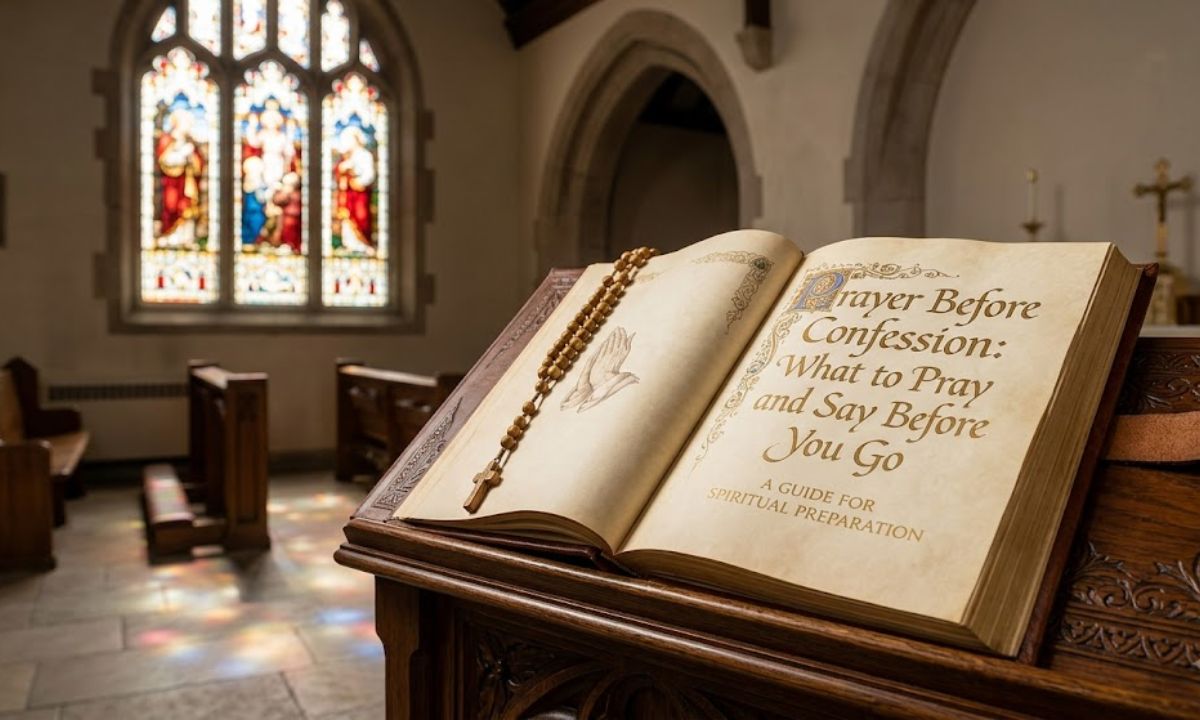
What Is Prayer Before Confession?
Prayer before Confession is a short, personal conversation with God that helps you prepare your heart for the Sacrament of Reconciliation. It isn’t a formula you must recite word-for-word it’s a moment of honesty where you ask God for two things: the clarity to recognize your sins, and the courage to name them out loud.
Traditionally, Catholics use this time to invite the Holy Spirit into their self-reflection. The idea is simple: you can’t confess what you can’t see. So before you even walk into the church, prayer opens your eyes to the truth about your own choices, without excuses and without shame clouding the picture.
A classic version of this prayer sounds something like this:
O loving and merciful God, help me to make a good Confession. Help me examine my conscience so that I may tell the priest what sins I have committed and how often. Grant me true sorrow for my sins, and the firm resolve to sin no more.
You don’t need special training to pray this way. Some people prefer the traditional wording; others simply talk to God in their own words. Both are valid. What matters most is sincerity — showing up honestly, the way you’d talk to someone who already knows you completely and still loves you.
Why This Prayer Matters
- It shifts your mindset from fear to trust.
- It asks for the grace to see your sins clearly, not just vaguely.
- It prepares your heart for genuine sorrow, not just a checklist confession.
- It reminds you that Confession is about healing, not punishment.
Examination of Conscience: How to Prepare for Confession
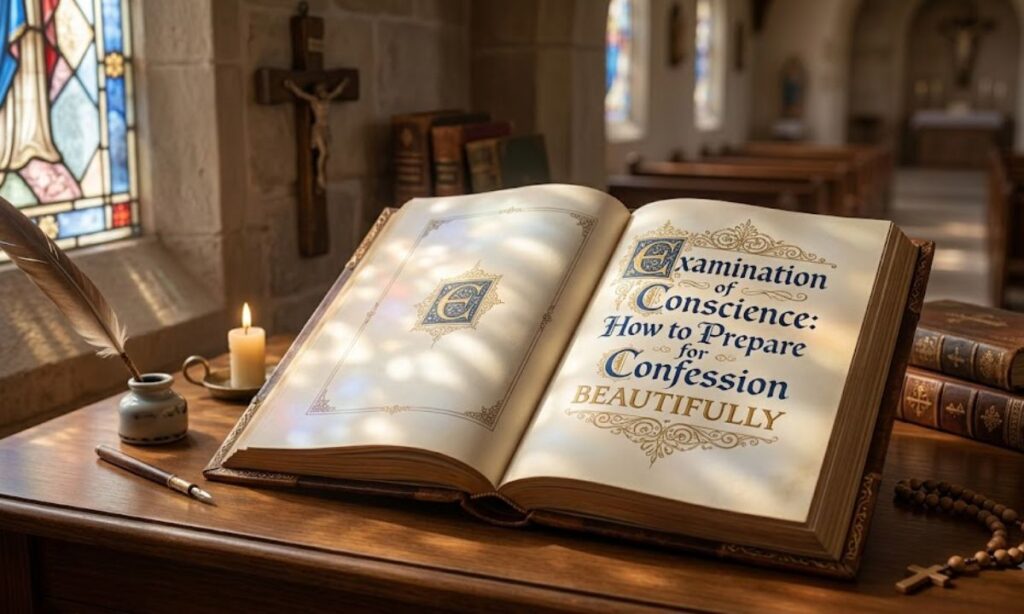
Before you can confess your sins, you need to actually remember them — and that’s where the examination of conscience comes in. This is a quiet period of self-reflection, usually done a few minutes before Mass or Confession, where you honestly review your thoughts, words, and actions since your last good Confession.
Most Catholics use the Ten Commandments as their framework, since each commandment naturally opens up a set of reflective questions. Others use the Seven Capital (Deadly) Sins, or a simpler daily-life checklist. There’s no single “correct” method — what matters is thoroughness and honesty.
A Simple Way to Examine Your Conscience
- Find a quiet space. Turn off distractions and give yourself five to ten uninterrupted minutes.
- Begin with a short prayer. Ask the Holy Spirit for light to see your sins clearly, not to be blinded by self-love or excuses.
- Reflect commandment by commandment (or category by category). Walk through areas like faith, honesty, relationships, purity, and generosity.
- Be specific. Instead of thinking “I was unkind,” recall the actual moment — who, what, and how often.
- Note serious (mortal) sins separately. These need to be confessed by kind and approximate number.
- End with sorrow, not shame. Recognizing sin should lead to contrition, not despair.
Common Areas to Reflect On
| Area of Life | Questions to Ask Yourself |
| Relationship with God | Have I prayed regularly? Missed Mass without reason? Doubted my faith? |
| Speech and honesty | Have I lied, gossiped, or used God’s name carelessly? |
| Relationships and family | Have I been impatient, unforgiving, or neglectful of loved ones? |
| Purity and self-control | Have I entertained impure thoughts or actions? |
| Generosity and honesty in dealings | Have I stolen, cheated, or been greedy with time or money? |
| Anger and pride | Have I held grudges, judged others harshly, or acted arrogantly? |
If writing things down helps you remember, jot a brief private note on paper. Many people bring a small list into the confessional simply so nerves don’t erase their memory once they’re sitting down.
The Act of Contrition: The Prayer That Confession Ends With
The Act of Contrition is the prayer you say after confessing your sins, right before or as the priest gives absolution. It’s the moment where you formally express sorrow for your sins and your intention to change. Nearly every version of this prayer includes three essential elements: sorrow for sin, acknowledgment that sin offends God, and a firm resolution to avoid sin going forward.
Here is one of the most commonly used traditional versions:
O my God, I am heartily sorry for having offended Thee, and I detest all my sins because I dread the loss of Heaven and the pains of Hell, but most of all because they offend Thee, my God, Who art all-good and deserving of all my love. I firmly resolve, with the help of Thy grace, to confess my sins, to do penance, and to amend my life. Amen.
Some parishes use a slightly modern version:
My God, I am sorry for my sins with all my heart. In choosing to do wrong and failing to do good, I have sinned against You, whom I should love above all things. I firmly intend, with Your help, to do penance, to sin no more, and to avoid whatever leads me to sin. Amen.
Why the Act of Contrition Matters
- It’s not just a formality it’s the heart of the sacrament.
- It expresses genuine sorrow, not just regret over consequences.
- It includes a resolution to change, which is essential to receiving grace.
- Priests often have a printed copy in the confessional, so you don’t need to memorize it perfectly.
If you forget the exact words, that’s completely fine. You can simply tell the priest, “I’m sorry for these and all my sins,” and mean it sincerely. What God wants is a contrite heart, not flawless recitation.
What to Say Before Confession Begins
Walking into the confessional for the first time — or the first time in years — can feel intimidating simply because people aren’t sure what to say. The good news: the opening line is short and the same every time.
Step-by-Step: Starting Confession
- Enter and make the Sign of the Cross. The priest will usually do this with you.
- Say the opening line. The traditional phrase is: “Bless me, Father, for I have sinned.”
- Mention how long it has been. For example: “It has been three months since my last Confession” — or, if it’s your first time, simply say so.
- Confess your sins. State them honestly, without over-explaining or justifying.
- Listen to the priest’s guidance. He may offer advice or ask a clarifying question.
- Receive your penance. This is usually a short prayer or act of charity.
- Pray for the Act of Contrition.
- Receive absolution, then leave in peace.
There’s no need to over-prepare a speech. Priests hear these words every single day, and their role is to guide you gently, not to judge you. If you’re nervous, you can even say that out loud: “Father, it’s been a while and I’m a little nervous.” Most priests will immediately help put you at ease.
A Simple Prayer for Confession You Can Use Anytime

Not everyone remembers long, formal prayers — and that’s okay. Sometimes the most powerful prayer before Confession is the simplest one. Here’s a short prayer you can use in the pew, in the car, or standing in line:
Lord, help me see myself clearly. Give me the courage to be honest, the humility to be sorry, and the grace to change. Thank You for Your mercy. Amen.
This kind of prayer works well because it’s easy to remember under pressure and hits the three essentials: clarity, honesty, and gratitude for mercy. You can adapt it in your own words, too — God isn’t grading your grammar. He’s listening to your heart.
Quick Prayer Options by Moment
- While waiting in line: A short plea for honesty and courage.
- Right before entering: A brief prayer to the Holy Spirit for clarity.
- If anxious: A prayer asking for peace and trust in God’s mercy rather than fear of judgment.
What Happens After Confession
Once you’ve confessed your sins and received absolution, the priest will typically give you a penance often a prayer, an act of kindness, or a moment of reflection. Completing this penance as soon as reasonably possible is part of finishing the sacrament well.
Many Catholics also say a short prayer of thanksgiving afterward, similar to this traditional one:
O Almighty and most merciful God, I give You thanks for this and all the graces and blessings You have bestowed upon me. Amen.
After Confession, Consider Doing the Following
- Complete your penance promptly, rather than putting it off.
- Sit quietly for a moment and let the relief settle in.
- Avoid re-analyzing your sins obsessively. Once absolved, they’re forgiven — trust that.
- Thank God simply, even in your own words.
It’s common to feel a noticeable lightness after Confession — many describe it as a weight lifting. That feeling isn’t just emotional; it reflects the real spiritual reality of grace restored.
Building a Habit Around Confession
Confession works best not as a once-a-year emergency measure, but as a regular spiritual habit. Many parishes offer Confession weekly, and spiritual directors often recommend going monthly, even for those without serious sins to confess, simply to stay attentive to smaller faults before they grow into bigger patterns.
Tips for Making Confession a Regular Practice
- Pick a recurring time, such as the first Saturday of each month.
- Pair it with Mass so it becomes part of an existing routine rather than an extra task.
- Keep a small examination-of-conscience list on your phone or in a notebook for quick reference.
- Don’t wait for “big” sins. Regular Confession keeps your conscience sensitive and honest.
- Be patient with yourself. Growth in virtue is gradual, not instant.
Treating Confession as routine rather than a last resort tends to reduce anxiety over time. The more familiar the process becomes, the less intimidating it feels, and the more it becomes what it’s meant to be: an encounter with mercy rather than a dreaded obligation.
FAQ’s
What is the best prayer to say before Confession?
Any sincere prayer works, but a common one is: “O loving and merciful God, help me make a good Confession and grant me true sorrow for my sins.” Simplicity and honesty matter more than exact wording.
Do I have to memorize the Act of Contrition word for word?
No. Most confessionals have a printed copy, and priests are happy to guide you through it if you forget the words.
What if I don’t remember all my sins?
Confess what you honestly remember. Sins forgotten in good faith are still covered by the mercy of absolution.
What do I say first when I enter the confessional?
Traditionally, you begin with: “Bless me, Father, for I have sinned,” followed by how long it’s been since your last Confession.
How often should Catholics go to Confession?
Church teaching requires Confession at least once a year if you’re aware of serious sin, but monthly Confession is widely encouraged for spiritual growth.
Is it normal to feel nervous before Confession?
Yes, it’s extremely common, even for lifelong Catholics. Priests are used to it and will help guide you gently through the process.
Conclusion
Prayer before Confession isn’t about getting the wording perfect, it’s about showing up honestly and asking God for the clarity and courage to be truly known. From a simple examination of conscience to the words you speak as you enter the confessional, every part of this process is designed to lead you toward peace, not fear.
Whether you use a centuries-old prayer or a few honest sentences in your own words, what matters most is a sincere heart. The next time you prepare for Confession, take a few quiet minutes beforehand, pray simply, and trust that mercy not judgment is waiting for you on the other side of that door.