Every day, across nearly every culture and faith, people pause what they’re doing to pray. Some check an app for exact minutes; others simply know, by habit, when it’s time. But behind that simple act sits something surprisingly precise: a system of timing built on the movement of the sun, centuries of tradition, and for many faiths real theological meaning.
This guide breaks down what prayer times actually are, how the five daily Islamic prayers are structured and calculated, why keeping fixed times matters so much, how Christian traditions approach prayer throughout the day, and how you can build a prayer schedule that actually fits your life.
What Are Prayer Times, Exactly?
Prayer times are the specific windows during the day set aside for structured, often obligatory, worship. They’re not arbitrary. In most traditions, these windows are tied to natural markers sunrise, solar noon, sunset rather than the clock itself, which is why the exact time shifts a little every single day.
A few things define prayer times across most belief systems:
- They repeat on a daily rhythm, usually several times from dawn to night.
- They’re anchored to astronomical events, not fixed clock hours.
- They shift depending on your location, latitude, and the season.
- Each one carries its own spiritual purpose, not just a repeated ritual.
The most widely followed structured prayer schedule in the world today is the Islamic system of five daily prayers, known as Salah. Christianity has its own historical version — the canonical hours — which we’ll cover further down. Judaism, too, has three daily prayer services (Shacharit, Mincha, and Maariv) tied to similar solar markers, though this guide focuses primarily on Islamic and Christian prayer schedules.
Islamic Prayer Times: The Five Daily Prayers
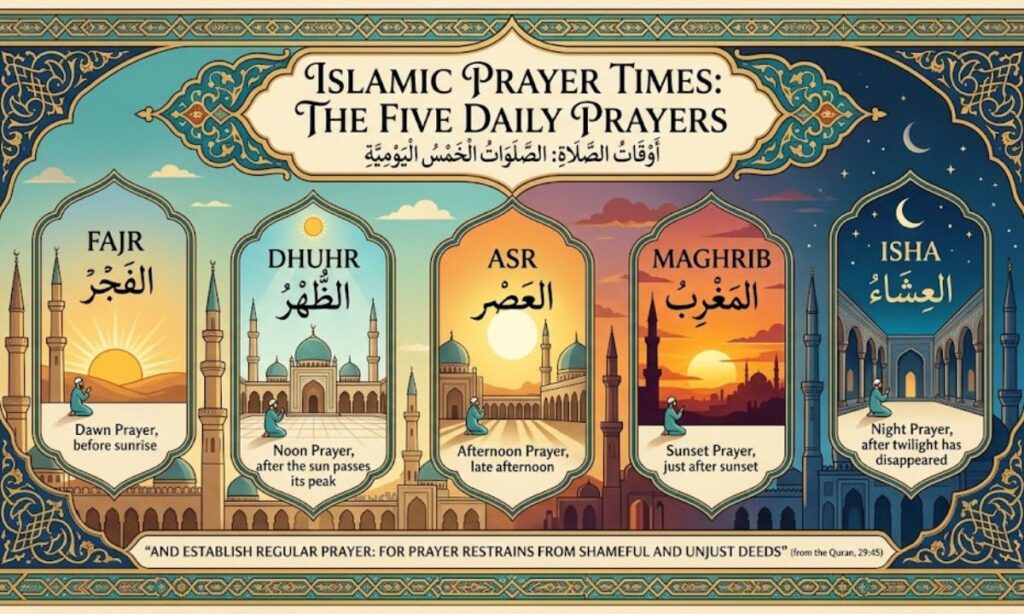
In Islam, Salah is the second pillar of the faith, and it’s built around five obligatory prayers spread across the day and night. Each prayer, known individually and collectively as Namaz in some regions, has its own defined start and end time, determined by the sun’s position relative to the observer’s location.
Missing the window for a prayer isn’t treated lightly in Islamic practice — timeliness itself is considered part of the act of worship, not just a scheduling detail.
Here’s a quick overview before we go deeper into each one:
| Prayer | Approximate Time Window | Rak’ahs (Fard) |
| Fajr | Dawn until sunrise | 2 |
| Dhuhr | Midday, after the sun passes its peak | 4 |
| Asr | Mid-afternoon until just before sunset | 4 |
| Maghrib | Just after sunset | 3 |
| Isha | Nightfall until dawn | 4 |
Fajr
Fajr is the first prayer of the day, and its window opens at the break of dawn — technically, when the first light appears on the horizon — and closes at sunrise. It’s prayed in near-darkness or the earliest light, which is part of why scholars consider it a strong test of discipline and sincerity.
Dhuhr
Dhuhr begins once the sun passes its highest point in the sky (solar noon) and starts to decline, and its window remains open until the shadow of an object equals its own length (in addition to the shadow that existed at noon). It’s typically prayed in the early afternoon.
Asr
Asr picks up right where Dhuhr’s window closes and extends until shortly before sunset. Many people find Asr the easiest prayer to miss simply because it falls in the middle of a busy workday, which is part of why scholars have historically emphasized guarding it carefully.
Maghrib
Maghrib begins immediately after sunset and has a comparatively short window — it lasts until the last traces of red or orange light (the twilight glow) disappear from the western sky. Because the window is tighter than the others, Maghrib is usually prayed promptly.
Isha
Isha starts once the evening twilight has fully faded and technically remains valid until the following Fajr begins, though it’s best performed before midnight. It’s the final prayer of the day and closes the cycle before it begins again with Fajr.
How These Prayer Times Are Calculated
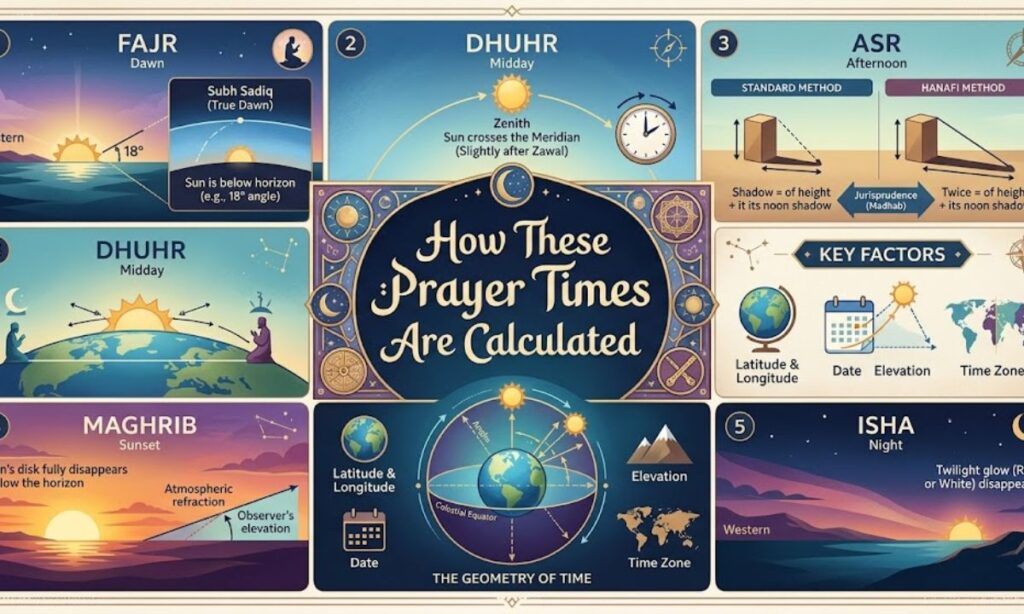
Islamic prayer times aren’t pulled from a fixed clock — they’re calculated using the sun’s angle relative to the horizon at a specific location. This is why a prayer timetable in Karachi looks different from one in London or Toronto, even on the same calendar day.
A few factors go into the calculation:
- Geographic coordinates — latitude and longitude determine how the sun moves across the sky at your location.
- Solar angle conventions — different Islamic authorities and calculation methods (such as the Muslim World League, Umm al-Qura, or ISNA) use slightly different sun-angle thresholds for Fajr and Isha, which is why timetables can vary by a few minutes between apps.
- Elevation and local adjustments — some methods factor in altitude or add manual safety margins.
- Date and season — day length changes throughout the year, which shifts every single prayer window slightly, sometimes by minutes, sometimes dramatically at extreme latitudes.
This is also why prayer time apps and mosque timetables ask you to select a calculation method and, sometimes, a madhab (school of thought) — particularly for Asr, since the Hanafi school defines the start of Asr differently from the other three major schools.
Why Fixed Prayer Times Matter
Fixed prayer times aren’t just a scheduling convenience — they carry real weight in Islamic theology and, more broadly, in the psychology of habit-building.
Spiritual discipline. Praying at set intervals keeps a person consciously connected to their faith throughout the day, rather than treating worship as an occasional or emotional act.
Structure and consistency. A recurring schedule turns prayer into a habit rather than something that has to be remembered or decided on each time, which research on habit formation consistently shows is easier to sustain.
Community and unity. Because prayer windows are shared across an entire community, they create natural moments for congregational prayer, particularly at the mosque, reinforcing a shared rhythm across millions of people simultaneously.
A framework for the day. Many people who practice five daily prayers describe them as natural checkpoints — a way to pause, reset, and refocus rather than letting the day run together unstructured.
Obligation and accountability. In Islamic teaching, each prayer performed within its window is considered fully valid (Fard), while delaying it without a valid excuse carries spiritual consequences, which is part of why timing is treated as inseparable from the prayer itself.
Christian Prayer Times: Praying Through the Day
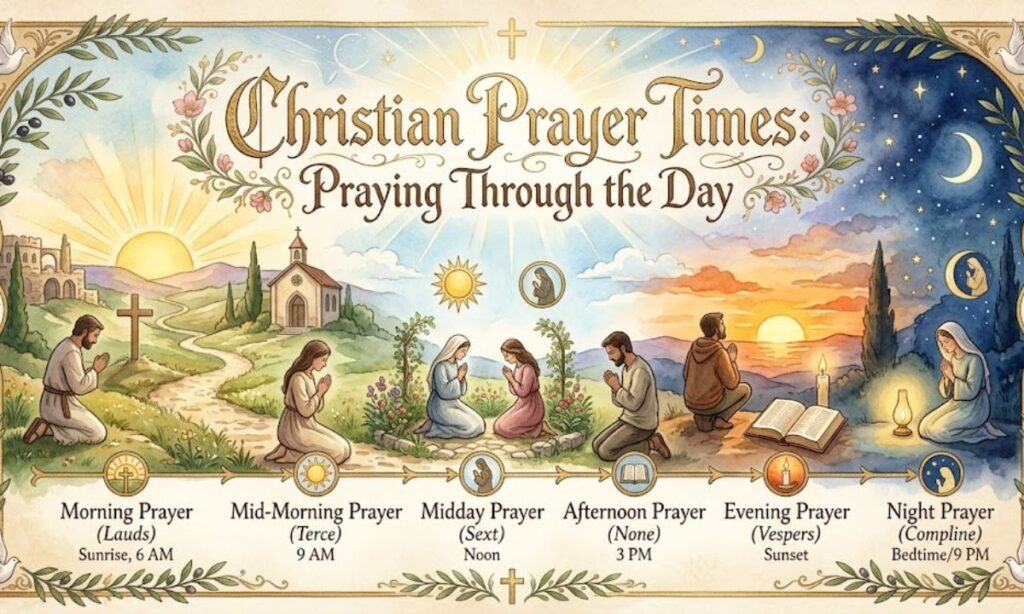
Christianity has its own long history of scheduled daily prayer, generally referred to as the canonical hours, the Divine Office, or the Liturgy of the Hours. While it’s less commonly practiced by the average layperson today compared to the five daily Islamic prayers, it remains central to monastic life and is still observed by clergy, religious communities, and many devoted laypeople.
The tradition traces back to Jewish prayer customs and early Christian practice, where believers prayed at the third, sixth, and ninth hours of the day. Over time, particularly through the Rule of Saint Benedict in the sixth century, this expanded into a structured set of prayer periods observed roughly every three hours.
A traditional breakdown of the canonical hours looks like this:
| Hour | Approximate Time | Purpose |
| Matins (Vigils) | Midnight | Night vigil and reflection |
| Lauds | Early morning (around dawn) | Morning praise |
| Prime | Early morning (~6 a.m.) | Start of the working day |
| Terce | Mid-morning (~9 a.m.) | Third hour of the day |
| Sext | Midday (~noon) | Sixth hour of the day |
| None | Mid-afternoon (~3 p.m.) | Ninth hour of the day |
| Vespers | Evening | Evening praise |
| Compline | Night, before sleep | Closing the day in prayer |
Not every Christian tradition observes all eight hours today. After the Second Vatican Council, the Catholic Church’s Liturgy of the Hours was reformed and simplified to make it more accessible to laypeople, often condensed into morning prayer, midday prayer, evening prayer, and night prayer. Many Protestant traditions instead emphasize personal, less formally scheduled prayer, though structured prayer books and daily offices are still widely used in Anglican, Lutheran, and Orthodox communities.
The underlying idea, though, mirrors the Islamic approach in one important way: prayer isn’t meant to be a once-a-week event. It’s meant to punctuate the day.
Building Your Own Schedule

Whether you’re establishing five daily prayers for the first time, trying to return to consistency after falling out of the habit, or simply want a more prayerful rhythm to your day, a workable schedule matters more than a perfect one.
Here are practical steps that actually hold up in daily life:
- Use a reliable prayer time source. A trusted app or local mosque timetable, set to your correct location and calculation method, removes the guesswork.
- Build in a buffer, not a deadline. Aim to pray early within a prayer’s window rather than right at the edge of it, so unexpected delays don’t cause you to miss it entirely.
- Anchor prayers to existing habits. Pairing prayer with something you already do daily — waking up, lunch break, closing your laptop — makes it far easier to remember.
- Set gentle reminders, not just alarms. A calendar block or a quiet notification tends to work better long-term than a jarring alarm you learn to ignore.
- Plan around your work or school schedule. If Dhuhr or Asr consistently falls during a meeting, look for a five-to-ten-minute window you can protect in advance rather than trying to find time in the moment.
- Track consistency, not perfection. A simple daily checklist or habit tracker helps you notice patterns — like which prayer you tend to miss — so you can adjust rather than feel discouraged.
- Adjust for travel and season. Prayer windows shift with your location and time of year, so recheck your schedule whenever you travel or as daylight hours change.
The goal isn’t a rigid, stressful system — it’s a rhythm flexible enough to survive a busy week but structured enough that prayer doesn’t quietly disappear from your day.
FAQ’s
How many times a day do Muslims pray?
Muslims pray five times a day: Fajr, Dhuhr, Asr, Maghrib, and Isha, each within its own defined time window.
Do prayer times change every day?
Yes. Because they’re based on the sun’s position, prayer times shift slightly each day and vary significantly by location and season.
What happens if you miss a prayer time?
Missed prayers should generally be made up as soon as possible (Qada), though intentionally delaying prayer without valid reason is discouraged in Islamic teaching.
Why do prayer times differ between apps?
Different apps use different calculation methods and sun-angle conventions for Fajr and Isha, which can create a gap of a few minutes between sources.
What is the best prayer time calculation method to use?
The most accurate method is usually the one recommended by your local mosque or Islamic authority, since it reflects regional convention and consensus.
Do Christians have fixed daily prayer times?
Yes, through the canonical hours or Liturgy of the Hours, historically prayed roughly every three hours, though modern practice is often simplified to a few key times a day.
Can I combine prayers if I’m traveling?
In Islam, travelers are permitted to shorten certain prayers and, under specific conditions, combine Dhuhr with Asr or Maghrib with Isha.
Conclusion
Prayer times exist to give structure to something that could otherwise slip through the cracks of a busy day. Whether it’s the five precisely calculated daily prayers in Islam or the historic rhythm of the Christian canonical hours, the underlying idea is the same: faith works best when it’s woven into the shape of everyday life, not saved for occasional moments.
Understanding how these times are calculated and why they’re treated with such importance makes it easier to build a schedule you can actually stick to. Start with a reliable source for your local prayer times, anchor your prayers to habits you already have, and give yourself room to adjust as life changes. Consistency, not perfection, is what turns a prayer schedule into a lasting spiritual practice.