There’s a particular kind of fear that shows up at 2 a.m. when a loved one hasn’t texted back, when the diagnosis is still pending, when you’re driving through a storm, or when life just feels unsteady for no clear reason. In those moments, most people don’t reach for a theology book. They reach for a prayer.
But “praying for protection” can feel vague. Do you ask for safety? For peace? For angels to physically intervene? What happens when you pray hard and something bad still happens anyway?
This guide walks through what a prayer for protection actually is, what the Bible says about it — especially in Psalm 91 and Ephesians 6 — and gives you real, ready-to-pray words for yourself, your family, and the specific situation you’re facing right now.
You don’t need seminary training or a perfectly worded script to pray for protection. You need to understand what you’re actually asking, and what God actually promises in return. That’s what makes a protection prayer sustainable not just something you reach for in panic, but something you can return to as a steady practice, even on ordinary days when nothing feels threatening at all.
What You’re Actually Asking For
When you pray for protection, you’re not casting a spell or asking God to wrap you in an invisible bubble where nothing bad can ever touch you. You’re asking for something more layered than that.
A biblical prayer for protection usually asks for one or more of these things:
- Physical safety — from accidents, illness, violence, or harm
- Spiritual covering — protection from temptation, deception, or spiritual attack
- Emotional steadiness — peace that holds even when circumstances don’t
- Divine presence — the assurance that you are not facing whatever this is alone
- Guidance — protection that includes being kept from wrong paths, not just wrong outcomes
Here’s the part that trips people up: protection in Scripture rarely means “nothing bad will ever happen to you.” It means something closer to “you will not face this without Me.” Even the most protected people in the Bible — David, Daniel, Paul — walked through real danger. What they were promised, and what you’re praying for, is God’s presence and ultimate purpose in the middle of it, not a guaranteed escape from every hard thing.
That distinction matters. If you pray for protection expecting a force field, disappointment is almost guaranteed. If you pray for protection expecting God’s covering, presence, and sovereignty over the outcome, your prayer life becomes far more durable — because it’s not built on a promise the Bible never actually made.
It also changes how you handle unanswered-feeling prayers. If protection means “guaranteed safety,” then a hard season can feel like proof God isn’t listening. If protection means “God’s presence and purpose through whatever comes,” a hard season becomes something you walk through with Him rather than evidence He’s absent. That shift in expectation is often the single biggest factor in whether someone’s prayer life survives a genuinely difficult year.
Psalm 91: The Protection Psalm
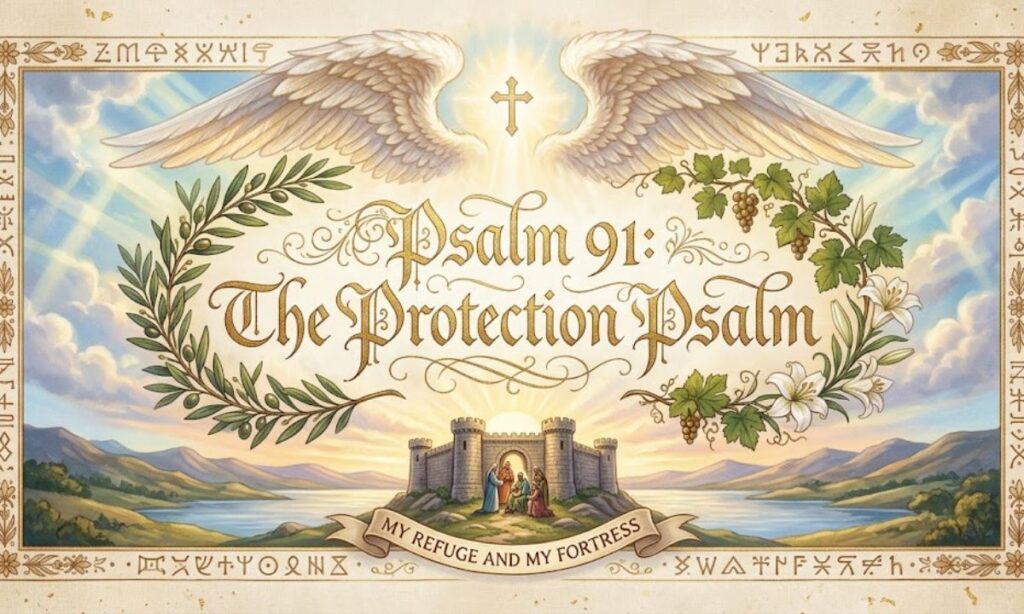
If you’ve ever searched for a prayer for protection, you’ve almost certainly landed on Psalm 91. It’s the go-to chapter for a reason — it’s the most concentrated, vivid picture of God’s covering anywhere in Scripture.
The psalm opens with an image of shelter: the one who dwells in “the secret place of the Most High” rests in the shadow of the Almighty. From there, it moves through a series of promises — deliverance from hidden traps, protection from disease, refuge under God’s wings, freedom from the fear that stalks in darkness, and angels dispatched to guard every step.
A few things are worth noticing about how this psalm actually works:
- It’s conditional on relationship, not performance. The protection described belongs to “the one who dwells” and “abides” — language of ongoing closeness, not a one-time favor asked of a stranger.
- It addresses fear directly. Verses 5-6 name the terror of night, the arrow by day, the plague in darkness — this psalm was written for people who were genuinely afraid, not for people with tidy, calm lives.
- It ends with God speaking in the first person. The final verses shift from the psalmist’s voice to God’s own promise: “I will answer him… I will be with him in trouble… I will deliver him.” That shift is significant — it turns the psalm from wishful poetry into a direct pledge.
Many people pray Psalm 91 word-for-word, substituting their own name or the name of a loved one into the text. Others use it as a framework, praying its themes — refuge, deliverance, angelic protection, long life — in their own words. Both approaches are common, and both are effective ways to let Scripture shape your prayer instead of guessing at what to say.
One practical way to use this psalm: read it slowly, pause at each promise, and turn it into a personal line. When you reach “he will cover you with his feathers,” pause and pray, “Lord, cover me the way this verse describes — hide me under Your care today.” Praying the psalm this way, phrase by phrase, tends to feel far more personal than reciting it straight through, and it forces you to actually sit with what each line is promising instead of moving past it too quickly.
What Protection Prayer Is Not
Before going further, it helps to clear away a few misunderstandings, because they quietly damage people’s faith when reality doesn’t match their expectations.
| Misconception | What’s actually true |
| Praying for protection guarantees nothing bad will happen | Protection prayers ask for God’s covering and presence — not a life free from all risk or suffering |
| If something bad happens, your prayer “failed” or you didn’t have enough faith | Faithful, godly people in Scripture faced danger, illness, and loss despite deep faith |
| Protection prayer is a formula — say the right words and you’re safe | Scripture frames protection as flowing from relationship and trust, not from reciting a script |
| Only “spiritual” threats need protection prayer | Protection prayer covers the physical, emotional, mental, and spiritual — all of it |
| You need special authority or training to pray for protection | Any believer can pray this prayer — it doesn’t require formal permission or a particular role |
Understanding what protection prayer isn’t actually makes the prayer itself more honest. You’re not negotiating a guarantee. You’re placing yourself, and the people you love, under God’s care and trusting His character even when you can’t see the outcome. That’s a very different posture than trying to “get it right” so nothing bad happens — and it’s a far more sustainable one, especially when life doesn’t cooperate.
Praying for Protection Over Your Family

Most people don’t only pray for themselves. Parents pray over kids leaving for school. Spouses pray over each other before a commute. Adult children pray over aging parents. Praying protection over family carries a particular weight, because the fear isn’t abstract — it’s tied to people you’d do anything to keep safe.
A few practical starting points when praying for your family:
- Pray specifically, not just generally. Instead of “protect my family,” try naming what you’re actually worried about — a teenager’s first solo drive, a spouse’s late shift, a child’s health concern.
- Pray over their hearts, not just their circumstances. Ask God to guard their minds from anxiety, their choices from bad influence, and their faith from discouragement — not only their physical safety.
- Pray it out loud when you can. Praying protection over a sleeping child, an empty bedroom, or a car before a trip is a practice many families find grounding, even if no one else hears it.
- Make it a rhythm, not a one-time request. Covering your household in prayer daily or weekly builds a habit of trust rather than a panic reflex that only shows up in a crisis.
- Include what you can’t control. You can’t protect your adult children from every decision they make. You can ask God to be present in the decisions you have no say over.
Praying protection over family also means being honest that you can’t control outcomes for people you love — and that’s often the hardest part. The prayer isn’t a mechanism for controlling them from a distance. It’s a way of releasing what you can’t control into hands you trust more than your own.
The Armor of God: Ephesians 6
Psalm 91 pictures protection as shelter. Ephesians 6:10-18 pictures it as armor — something you actively put on, piece by piece, before you walk into the day.
Paul writes this passage to a church facing real opposition, and the imagery is deliberately military. He’s not describing a passive shield that surrounds you automatically. He’s describing gear you choose to wear.
Here’s how the pieces break down:
| Armor Piece | What It Represents | What It Guards Against |
| Belt of Truth | Living grounded in what’s actually true | Deception, confusion, self-doubt |
| Breastplate of Righteousness | A right standing with God, not self-righteousness | Guilt, shame, condemnation |
| Shoes of the Gospel of Peace | Being ready to move, rooted in peace | Instability, being caught off guard |
| Shield of Faith | Active trust in God’s character | “Flaming arrows” — sudden attacks of fear or doubt |
| Helmet of Salvation | Protecting your mind with your identity in Christ | Despair, distorted thinking |
| Sword of the Spirit (the Word) | Scripture itself, actively used | Lies, temptation, spiritual confusion |
What makes this passage distinct from most protection prayers is the final instruction: “praying always with all prayer and supplication in the Spirit.” The armor isn’t complete without prayer woven through it. You don’t just put the armor on once — you keep praying as you wear it, because the battle Paul describes isn’t a single event, it’s ongoing.
Praying through the armor of God, piece by piece, each morning is one of the most common practices among people who pray protection prayers regularly. It gives structure to what could otherwise feel like a vague request, and it reframes protection as something you participate in, not just something that happens to you.
Prayer for Protection in the Psalms Beyond Psalm 91
Psalm 91 gets the spotlight, but it’s far from the only place in the Psalms where protection is the theme. A few worth knowing:
- Psalm 3 — written while David was fleeing his own son’s rebellion, this psalm holds real fear (“ten thousands of people who have set themselves against me”) alongside real trust (“I will not be afraid”).
- Psalm 23 — better known for comfort than protection, but “I will fear no evil, for you are with me” is one of the clearest protection statements in Scripture, tied directly to presence rather than the absence of danger.
- Psalm 27 — opens with “The Lord is my light and my salvation; whom shall I fear?” and moves through a request to be hidden “in the shelter of his tent” during trouble.
- Psalm 34 — includes the well-known promise that the angel of the Lord “encamps around those who fear him,” a verse many people pray over their homes.
- Psalm 121 — sometimes called the traveler’s psalm, this one focuses on God as the one who “will not let your foot be moved” and who “will keep your going out and your coming in.”
What ties these psalms together is that none of them were written by people living comfortable, danger-free lives. They were written in exile, in conflict, in grief, and in fear — which is exactly why they still resonate with people praying protection prayers today. These aren’t theoretical promises written from safety. They’re prayers written from the middle of real threat, which is what makes them usable in yours.
Actual Prayers for Protection to Use
Sometimes you don’t need an explanation — you need words. Here are four prayers you can pray as they are, adapt, or use as a starting point for your own.
A general prayer for daily protection:
Heavenly Father, I come to You today asking for Your covering over my life. Surround me with Your presence wherever I go. Guard my mind from fear, my body from harm, and my heart from doubt. Where I am weak, be my strength. Where I am afraid, be my peace. I trust You with today — every hour, every decision, every unknown. Keep me under the shadow of Your wings. In Jesus’ name, Amen.
A prayer for protection over your family:
Lord, I lift up my family into Your hands. Watch over each one of them today — guard their hearts, their minds, and their bodies. Protect them from harm I cannot see and dangers I cannot prevent. Where I have no control, remind me that You do. Keep our home a place of peace, and keep each person I love close to You. Surround them with Your angels and Your presence, now and always. In Jesus’ name, Amen.
A prayer for spiritual protection:
Father, I ask for Your protection over my spirit today. Guard my mind from lies, my heart from deception, and my faith from discouragement. Clothe me in Your armor — truth, righteousness, peace, faith, salvation, and Your Word. Where the enemy seeks to plant fear or doubt, silence it with Your truth. Keep me anchored in who You say I am, not in what I feel. In Jesus’ name, Amen.
A short prayer for a specific situation:
Lord, I don’t fully know what’s ahead of me right now, but You do. I ask for Your protection over this situation — over my safety, my peace, and my heart. Go before me, be beside me, and hold me steady. I trust You with what I can’t control. In Jesus’ name, Amen.
When You’re Praying in a Crisis
Crisis prayer is different from daily prayer. When something is actively happening — a medical emergency, a frightening phone call, a dangerous situation unfolding in real time — long, carefully worded prayers aren’t realistic, and they don’t need to be.
A few things that help in the moment:
- Short is fine. “Jesus, help” is a complete prayer. God doesn’t require eloquence, especially in crisis.
- Repetition is fine too. Praying the same short phrase over and over — “Lord, protect them,” “God, be near” — isn’t a lack of faith. It’s often exactly what faith sounds like under pressure.
- You don’t have to feel calm to pray. Crisis prayer often comes out shaky, tearful, or fragmented. That doesn’t make it less real.
- It’s okay to pray while you act. Praying protection over a loved one on the way to the hospital, while calling for help, or while driving through danger is not a substitute for taking action — it’s meant to happen alongside it.
- Scripture can steady you when your own words won’t come. Praying a familiar verse — Psalm 23, Psalm 91, Philippians 4:6-7 — gives your mind something solid to hold onto when panic makes it hard to form original sentences.
Crisis prayer for protection isn’t about getting the words right. It’s about turning toward God in the middle of fear instead of trying to white-knuckle your way through it alone. Even a single sentence, prayed honestly, counts.
If you’re waiting on news — test results, a loved one in surgery, someone traveling through bad weather — the waiting itself can feel like its own crisis. In that stretch, it can help to set a simple rhythm: pray briefly, do something with your hands (make tea, fold laundry, take a walk), and pray briefly again rather than sitting in a single unbroken loop of worry. This isn’t a technique for controlling the outcome. It’s a way of staying present with God through the waiting instead of being consumed by it.
Carrying It Without Spiraling
Here’s the tension nobody fully resolves: you can pray sincerely for protection and still feel afraid. You can trust God and still lie awake worrying. That doesn’t mean your faith is broken — it means you’re human.
A few things that help people carry this without spiraling into constant anxiety:
- Separate praying from ruminating. Praying about a fear once, with intention, is different from replaying the worst-case scenario in your head for hours. If you notice you’re doing the second one, it can help to consciously hand the thought back to God each time it resurfaces, rather than trying to think your way to safety.
- Let the prayer end. It’s okay to pray, say “Amen,” and move on with your day — even if the fear hasn’t fully lifted yet. You don’t have to feel resolved before you stop praying.
- Pair prayer with practical steps. Praying for safety on a drive doesn’t mean skipping your seatbelt. Praying for your health doesn’t replace the doctor’s appointment. Protection prayer and practical wisdom work together, not against each other.
- Watch for prayer becoming a control tactic. If you find yourself needing to pray a certain number of times, in a certain order, or with certain words to feel “safe enough,” that’s worth noticing — it’s a sign the fear is driving the prayer, rather than trust.
- Give yourself permission to ask for help. If fear or anxiety feels constant rather than situational, talking with a pastor, counselor, or trusted friend is not a failure of faith. Prayer and support aren’t competing options.
The goal isn’t to pray your way into never feeling afraid again. It’s to keep bringing the fear back to God, over and over, instead of carrying it entirely on your own.
FAQ’s
Is it biblical to pray for protection?
Yes. Protection prayers run throughout Scripture, from David’s psalms to Paul’s letters, and Jesus Himself taught His followers to pray “deliver us from evil” in the Lord’s Prayer.
Does Psalm 91 guarantee nothing bad will happen to me?
No. Psalm 91 promises God’s presence, refuge, and ultimate care, but Scripture elsewhere shows faithful people facing real danger and hardship despite deep trust in God.
What’s the difference between praying for protection and praying for safety?
They overlap, but protection often includes spiritual and emotional covering, while safety typically refers narrowly to physical harm — a good protection prayer usually covers both.
Can I pray Psalm 91 over someone else, like my child?
Yes. Many people personalize Psalm 91 by inserting a loved one’s name in place of “he” or “the one who dwells,” praying the psalm’s promises directly over that person.
Why do bad things still happen to people who pray for protection?
Scripture doesn’t promise a life free from hardship — it promises God’s presence and purpose within it, which is a different kind of protection than the absence of all difficulty.
How often should I pray for protection?
There’s no set rule. Many people pray it daily as part of a morning routine, while others pray it specifically when facing a known risk, travel, or a season of fear.
What Bible verse is best for protection in a crisis?
Psalm 91, Psalm 23:4, and Philippians 4:6-7 are commonly used in crisis moments because they’re short enough to recall quickly and directly address fear.
Conclusion
Praying for protection isn’t about finding a magic phrase that guarantees safety. It’s about bringing your very real fears for yourself, for the people you love, for situations you can’t control to a God who invites that honesty. Psalm 91 offers shelter. Ephesians 6 offers armor. The Psalms beyond that offer proof that people who were genuinely afraid still found solid ground in prayer.
Whether you’re facing a specific crisis tonight or simply want a steadier daily rhythm, you don’t need perfect words. You need honest ones. Start with one of the prayers above, adapt it to your own voice, and let it become a habit rather than a last resort. That’s what a prayer for protection is actually for not a guarantee against every hard thing, but a place to stand while you face it.